

Introduction
From autonomous drones and unmanned ground vehicles to marine vessels, industrial robots, and precision surveying systems, modern intelligent platforms all rely on one fundamental capability knowing their orientation accurately and continuously.
Regardless of the application, every moving platform needs reliable information about its roll, pitch, and heading to maintain stability, navigate safely, and execute complex tasks. This is the role of an Attitude and Heading Reference System (AHRS).
Although AHRS technology is widely used in aerospace and industrial automation, many engineers still ask the same question:
How does an AHRS actually work?
The answer is much more than simply combining a gyroscope and an accelerometer. An AHRS integrates multiple sensors, advanced mathematical models, calibration techniques, and sensor fusion algorithms to transform raw measurements into stable, real-time orientation data.
This article explains how an AHRS works from an engineering perspective. You'll learn how each sensor contributes to attitude estimation, how sensor fusion algorithms eliminate measurement errors, what factors influence accuracy, and how industrial AHRS products are applied in UAVs, robotics, marine navigation, autonomous vehicles, and many other industries.
What Is an AHRS?
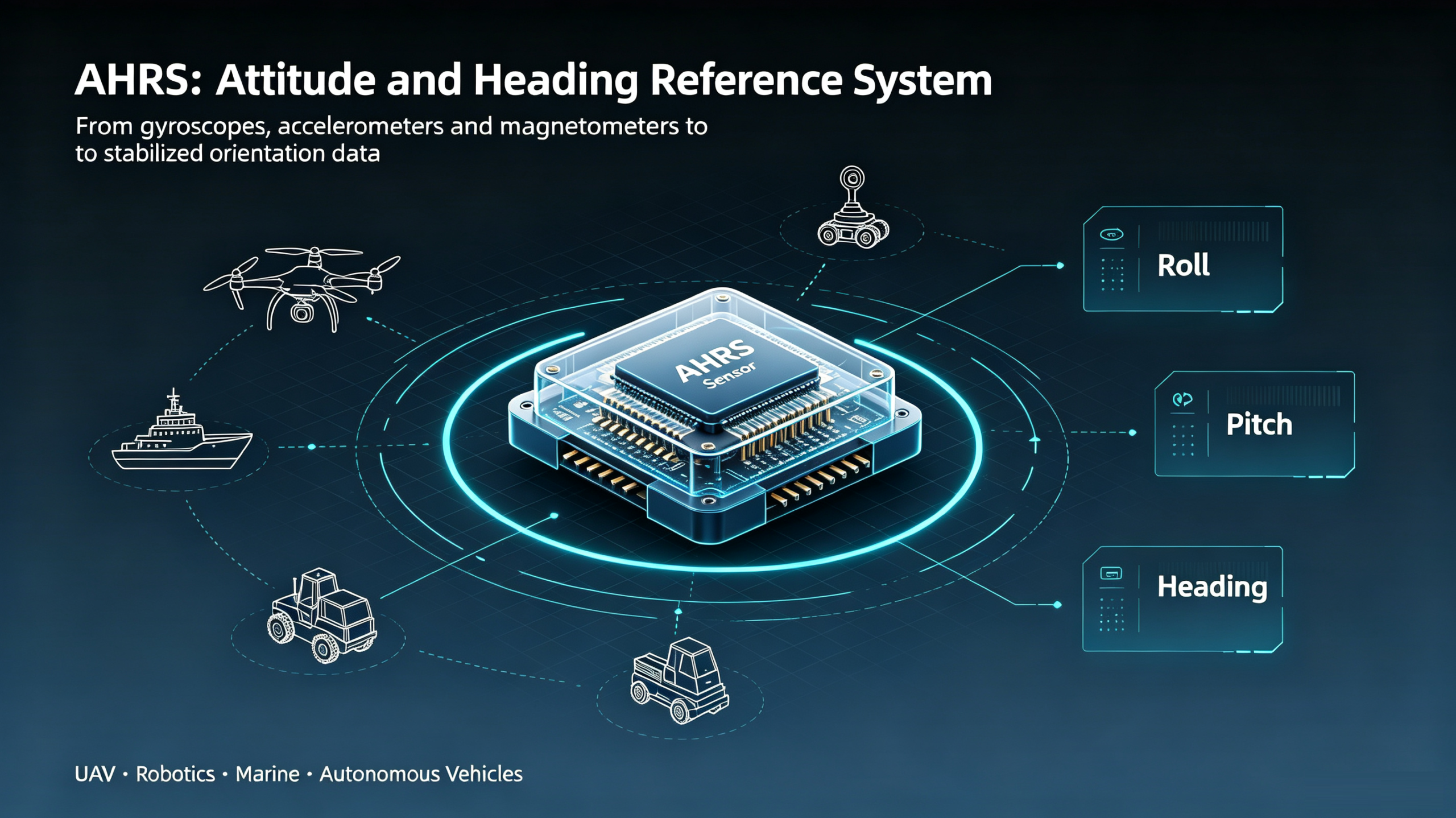
An Attitude and Heading Reference System (AHRS) is an intelligent orientation measurement system that determines the three-dimensional attitude of a moving object.
Unlike a conventional Inertial Measurement Unit (IMU), which outputs raw angular velocity and acceleration data, an AHRS performs onboard processing and directly provides usable orientation information.
Typical outputs include:
- Roll
- Pitch
- Heading (Yaw)
- Angular Velocity
- Linear Acceleration
This integrated approach greatly simplifies software development because engineers no longer need to design complex attitude estimation algorithms themselves.
Today, AHRS technology is widely adopted in:
- UAV flight control
- Autonomous mobile robots
- Marine navigation
- Antenna stabilization
- Camera gimbals
- Industrial automation
- Surveying equipment
- Agricultural machinery
Industrial Example: ERICCO ER-AHRS-5 and ER-AHRS-7
Industrial AHRS performance depends not only on sensor quality but also on calibration, sensor fusion algorithms, and environmental adaptability.
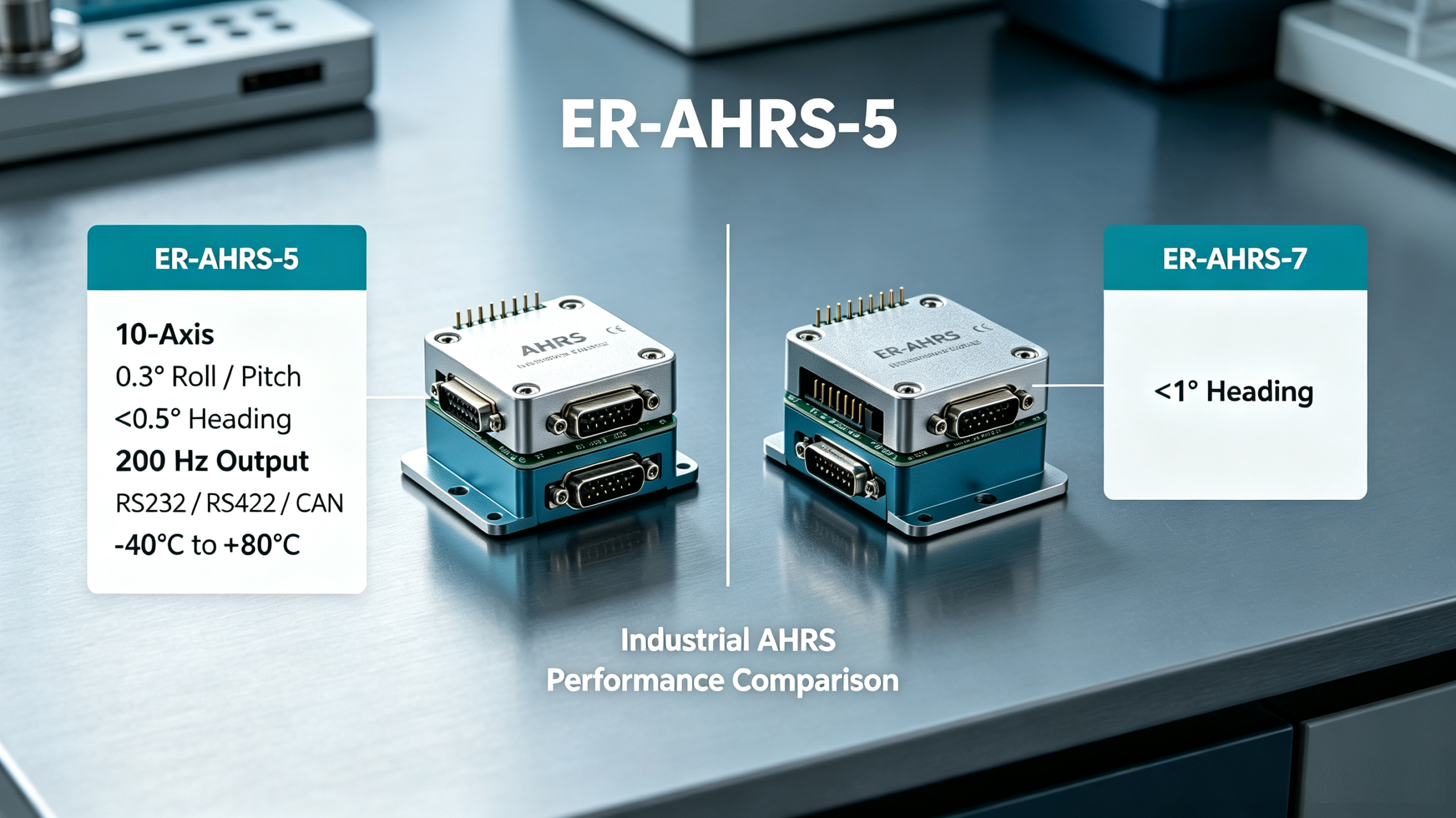
ERICCO ER-AHRS-5 integrates a 10-axis architecture consisting of a three-axis MEMS gyroscope, three-axis accelerometer, three-axis magnetometer, and a high-resolution barometer. It delivers 0.3° roll and pitch accuracy, better than 0.5° absolute heading accuracy, a 200 Hz output rate, and supports RS232, RS422, and CAN communication interfaces. Designed for harsh environments, it operates from −40°C to +80°C, making it suitable for UAVs, marine platforms, robotics, and autonomous vehicles.
For applications where cost efficiency is equally important, ER-AHRS-7 provides the same industrial 10-axis architecture with 0.3° roll and pitch accuracy, better than 1° heading accuracy, and the same industrial communication interfaces, offering an excellent balance between performance and affordability for commercial UAVs, agricultural machinery, and industrial automation.
These examples illustrate that an AHRS is not simply a sensor module, It is a complete orientation solution designed for reliable operation in real-world environments.
What Sensors Are Inside an AHRS?
An AHRS combines multiple sensors because no single sensor can accurately estimate orientation under every operating condition.
MEMS Gyroscope
The gyroscope measures angular velocity around the X, Y, and Z axes.
It provides fast response during rapid movement, making it the primary sensor for short-term attitude estimation.
However, gyroscopes are affected by:
- Bias drift
- Temperature variation
- Noise
- Long-term accumulated errors
Industrial products such as the ER-AHRS-5 and ER-AHRS-7 employ high-performance MEMS gyroscopes with bias instability ≤3°/h, angle random walk ≤0.21°/√h, and measurement ranges up to ±2000°/s, helping maintain stable orientation during high-dynamic motion.
MEMS Accelerometer
The accelerometer measures linear acceleration and gravity.
Gravity provides an excellent long-term reference for calculating roll and pitch.
Advantages include:
- No cumulative drift
- Excellent long-term stability
- Reliable attitude correction
However, acceleration caused by vehicle motion can temporarily reduce measurement accuracy, which is why accelerometer data must be fused with gyroscope measurements.
Magnetometer
The magnetometer measures the Earth's magnetic field and provides heading information.
Without a magnetometer, gyroscope drift would gradually degrade yaw accuracy.
Industrial AHRS systems such as the ER-AHRS series integrate three-axis magnetic sensors with a measurement range of ±800 μT, together with magnetic calibration algorithms to improve heading reliability in complex electromagnetic environments.
Barometer
Many industrial AHRS systems also integrate a high-resolution barometric pressure sensor.
Both ER-AHRS-5 and ER-AHRS-7 include a barometer featuring a 24-bit ADC and approximately 10 cm altitude resolution, enabling smoother altitude estimation for UAVs and mobile platforms.
Although the barometer does not directly calculate attitude, it enhances overall navigation stability and vertical positioning performance.
How Does an AHRS Calculate Orientation?
The AHRS continuously transforms raw sensor measurements into reliable orientation information.
Its operating process can be summarized in six steps:
- Measure angular velocity using the gyroscope.
- Detect gravity with the accelerometer.
- Measure magnetic north using the magnetometer.
- Remove noise and compensate for sensor errors.
- Fuse all sensor data through mathematical algorithms.
- Output roll, pitch, and heading in real time.
Rather than relying on a single sensor, the AHRS continuously compares information from different sources and compensates for the weaknesses of each sensor.
This multi-sensor approach allows the system to maintain accurate orientation even during rapid motion or environmental disturbances.
Why Sensor Fusion Is the Core of AHRS
Sensor fusion is the defining feature that separates an AHRS from a standard IMU.
Each sensor has strengths and limitations:
| Sensor | Strength | Limitation |
|---|---|---|
| Gyroscope | Fast response | Drift over time |
| Accelerometer | Stable gravity reference | Sensitive to vibration and acceleration |
| Magnetometer | Absolute heading | Magnetic interference |
By combining all three sensors, the AHRS provides accurate, stable, and reliable orientation.
Complementary Filter
The Complementary Filter combines high-frequency gyroscope data with low-frequency accelerometer information.
Its advantages include:
- Low computational cost
- Simple implementation
- Fast response
This approach is commonly used in embedded systems with limited processing resources.
Kalman Filter
The Kalman Filter predicts system motion and continuously corrects its estimates using incoming sensor measurements.
Advantages include:
- Excellent noise suppression
- Improved long-term stability
- Higher attitude accuracy
- Better dynamic performance
For industrial applications, Kalman-based algorithms are often preferred because they provide reliable performance under varying operating conditions.
Extended Kalman Filter (EKF)
Since vehicle motion is nonlinear, many advanced AHRS systems adopt the Extended Kalman Filter.
EKF provides:
- More accurate attitude estimation
- Better handling of dynamic maneuvers
- Stronger robustness during UAV flight
- Improved performance for autonomous navigation
Today, EKF is widely used in aerospace, robotics, and intelligent transportation systems.
Coordinate Systems Used by an AHRS
Orientation calculations require multiple coordinate systems.
The most common include:
- Body Frame: Fixed to the vehicle itself.
- Navigation Frame: Typically represented as North-East-Down (NED) or East-North-Up (ENU).
- Earth Frame: Provides the global reference used in navigation systems. The AHRS continuously transforms measurements between these frames to calculate accurate attitude.
Common Sources of AHRS Errors
Even high-quality AHRS systems experience measurement errors.
Understanding these factors helps engineers improve system performance.
- Gyroscope Drift: Small bias errors gradually accumulate and affect orientation if left uncorrected.
- Temperature Effects: Sensor characteristics vary with temperature. Industrial-grade products compensate for these variations through calibration.
- Magnetic Interference: Electric motors, steel structures, and high-current cables may distort heading measurements.
- Installation Errors: Incorrect mounting angles reduce overall accuracy.
- Mechanical Vibration: High-frequency vibration introduces additional sensor noise. Industrial AHRS products minimize these effects using factory calibration, temperature compensation, vibration filtering, and optimized sensor fusion algorithms.
Industrial AHRS Comparison
Selecting an industrial AHRS requires evaluating more than attitude accuracy.
| Specification | ER-AHRS-5 | ER-AHRS-7 |
|---|---|---|
| Sensor Architecture | 10-Axis | 10-Axis |
| Roll Accuracy | 0.3° | 0.3° |
| Pitch Accuracy | 0.3° | 0.3° |
| Heading Accuracy | <0.5° | <1° |
| Gyroscope Bias Instability | ≤3°/h | ≤3°/h |
| Angle Random Walk | ≤0.21°/√h | ≤0.21°/√h |
| Output Rate | 200 Hz | 200 Hz |
| Interfaces | RS232 / RS422 / CAN | RS232 / RS422 / CAN |
| Operating Temperature | −40°C to +80°C | −40°C to +80°C |
The ER-AHRS-5 is better suited for applications requiring higher heading precision, while the ER-AHRS-7 provides excellent value for commercial and industrial projects where cost-performance balance is important.
Typical Applications
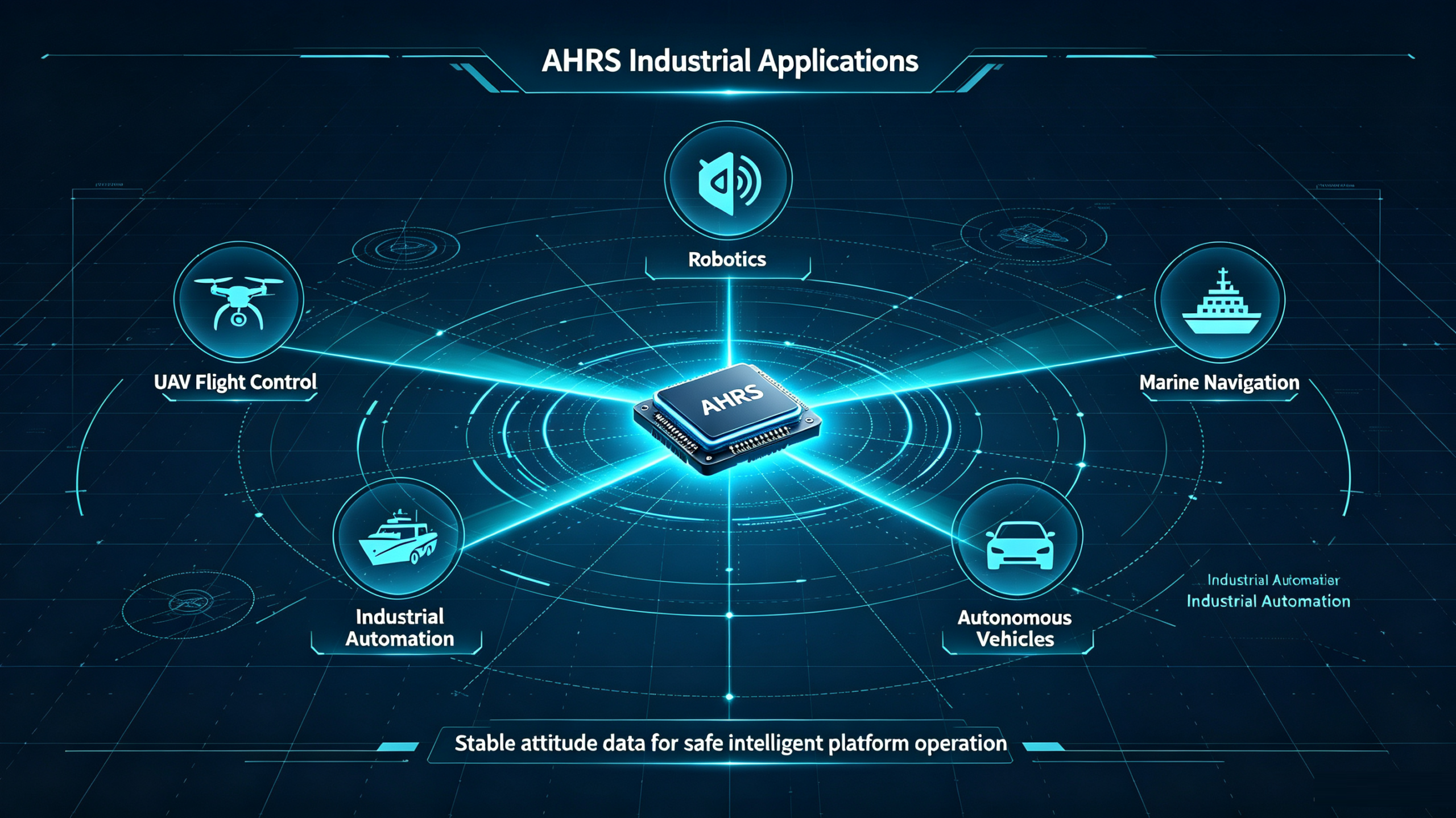
UAV Flight Control: AHRS provides stable roll, pitch, and heading for flight controllers, improving aircraft stability during takeoff, hovering, and autonomous flight.
Robotics: Robots use AHRS for balance control, motion tracking, and autonomous navigation.
Marine Navigation: Marine platforms rely on AHRS for radar stabilization, vessel attitude monitoring, and antenna alignment.
Autonomous Vehicles: Driverless vehicles require continuous orientation information for steering and motion control.
Surveying Equipment: AHRS improves platform stability and complements GNSS/INS systems in mapping applications.
Industrial Automation: Machine leveling, motion control, and intelligent manufacturing systems all benefit from reliable attitude information.
AHRS vs IMU
Although they share similar sensors, an IMU and an AHRS are fundamentally different.
| Feature | IMU | AHRS |
|---|---|---|
| Raw Gyroscope Data | ✔ | ✔ |
| Raw Accelerometer Data | ✔ | ✔ |
| Magnetometer | Optional | ✔ |
| Sensor Fusion | ✘ | ✔ |
| Roll & Pitch Output | ✘ | ✔ |
| Heading Output | ✘ | ✔ |
An IMU supplies raw measurements for developers who wish to implement their own algorithms.
An AHRS provides ready-to-use orientation information, reducing software complexity and accelerating product development.
FAQ
Q: Does an AHRS require GPS?
A: No. An AHRS determines orientation independently of GPS. However, it can work together with GNSS in integrated navigation systems.
Q: Can an AHRS work indoors?
A: Yes. Proper magnetic calibration is important because indoor environments may introduce magnetic interference.
Q: Why does an AHRS drift?
A: Drift mainly originates from gyroscope bias. Sensor fusion continuously corrects this using accelerometer and magnetometer measurements.
Q: Can an AHRS replace an INS?
A: No. AHRS estimates attitude, while an INS also calculates position and velocity.
Q: What should engineers evaluate when selecting an AHRS?
A: Besides accuracy, engineers should consider bias stability, update rate, communication interfaces, environmental adaptability, calibration quality, power consumption, and long-term reliability.
Conclusion
An AHRS is far more than a combination of sensors. It is an integrated orientation system that combines MEMS gyroscopes, accelerometers, magnetometers, barometers, and advanced sensor fusion algorithms to deliver accurate real-time attitude information.
Industrial solutions such as ERICCO's ER-AHRS-5 and ER-AHRS-7 demonstrate how high-quality sensors, robust calibration, and optimized filtering algorithms can provide dependable performance across demanding environments. With features including 0.3° roll and pitch accuracy, high-rate 200 Hz data output, industrial communication interfaces, and wide operating temperature ranges, these systems are well suited for UAVs, robotics, marine platforms, autonomous vehicles, and industrial automation.
When choosing an AHRS, focus not only on sensor specifications but also on the complete system design—algorithm performance, calibration capability, environmental robustness, and integration flexibility. A well-designed AHRS provides the reliable orientation data that modern intelligent systems need to operate safely, efficiently, and accurately.