Introduction
The global robotics industry is growing at an unprecedented rate. This complete buyer’s guide breaks down everything engineers need to know about
AHRS for Robotics, the core sensing hardware powering stable autonomous movement across all mobile robot platforms.
Autonomous mobile robots (AMRs), AGVs, humanoid robots, quadruped robots, warehouse automation equipment and outdoor inspection robots are now widely deployed across factories, ports and mines. These robots can operate with minimal human intervention, yet full autonomy relies on one critical component: a reliable Robot Orientation Sensor to deliver real-time posture data.
To navigate warehouses, climb uneven ground or complete precision inspections, every robot must continuously calculate roll, pitch and heading. Without accurate readings from a professional Attitude Sensor for Robot, balance control, path tracking and obstacle avoidance will fail entirely.
This is where an Attitude and Heading Reference System becomes an indispensable core Robot Navigation Sensor. Many engineers new to inertial hardware confuse standard inertial modules with purpose-built Robot AHRS, failing to grasp how dedicated Robotics AHRS streamlines navigation development.
A basic
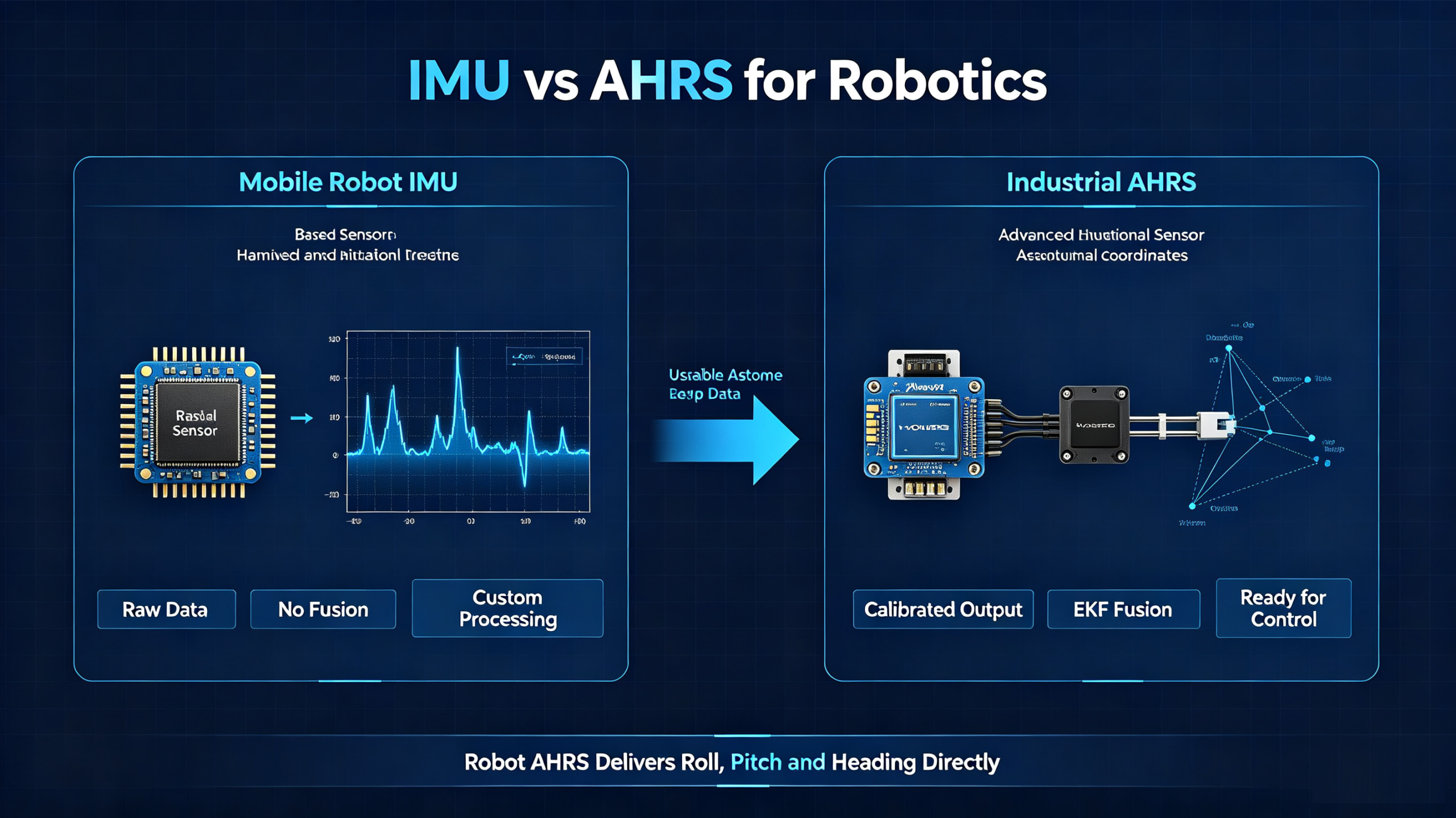
Mobile Robot IMU only outputs raw angular velocity and acceleration data, requiring teams to build complex fusion algorithms from scratch. In contrast, an
Industrial AHRS embeds multi-inertial sensors plus built-in sensor fusion algorithms to deliver calibrated, ready-to-use orientation readings directly to robot controllers.
Pre-processed data from quality AHRS for Robotics cuts down software development workload, improves navigation accuracy and stabilizes robot motion. Today, rugged Industrial AHRS hardware has become standard equipment for autonomous robots working in harsh indoor and outdoor environments.
This guide covers all core knowledge for robotics engineers:
- Core values that Robot AHRS brings to robotic navigation systems
- Internal sensor composition and working principle of professional Industrial AHRS
- How Robotics AHRS collaborates with multi-sensor fusion and SLAM pipelines
- Main robotic application scenarios where a reliable Robot Orientation Sensor is mandatory
- Key indicators to select high-performance Attitude Sensor for Robot hardware
- Clear functional comparison between Mobile Robot IMU and fully integrated AHRS for Robotics
- Common navigation errors and corresponding optimization methods for your Robot Navigation Sensor
- FAQ for on-site deployment and calibration of industrial-grade Robot AHRS
We also take ERICCO
ER-AHRS-5 and
ER-AHRS-7 flagship
Industrial AHRS units as real-world industrial examples to explain how premium
AHRS for Robotics meets demanding robotic performance requirements.
Why Mobile Robots Must Equip a Purpose-Built Robot AHRS
Unlike fixed production equipment, mobile robots keep changing position and posture during operation. Even tiny attitude errors will accumulate and trigger major risks: poor localization, failed obstacle detection and unstable movement.
A calibrated Robot AHRS continuously outputs reliable orientation feedback to robot controllers. It supports precise closed-loop motion adjustment under dynamic conditions, with four irreplaceable core values as below for any Robot Navigation Sensor.
1. Maintain Robot Balance and Dynamic Stability
Balance is the basic operating requirement for wheeled, legged and self-balancing robots, and no generic Mobile Robot IMU can deliver this stable posture data out of the box like dedicated Robotics AHRS.
Humanoid robots, quadruped inspection robots and service robots constantly adjust posture while walking or resisting external impact. A high-precision Attitude Sensor for Robot captures real-time roll and pitch changes instantly. The control system can send compensation commands before the robot loses stability.
Wheeled robots also rely on consistent output from their Robot Orientation Sensor when passing slopes, uneven ground or loading platforms. Accurate attitude data prevents trajectory drift caused by terrain changes.
2. Improve Multi-Sensor Autonomous Navigation
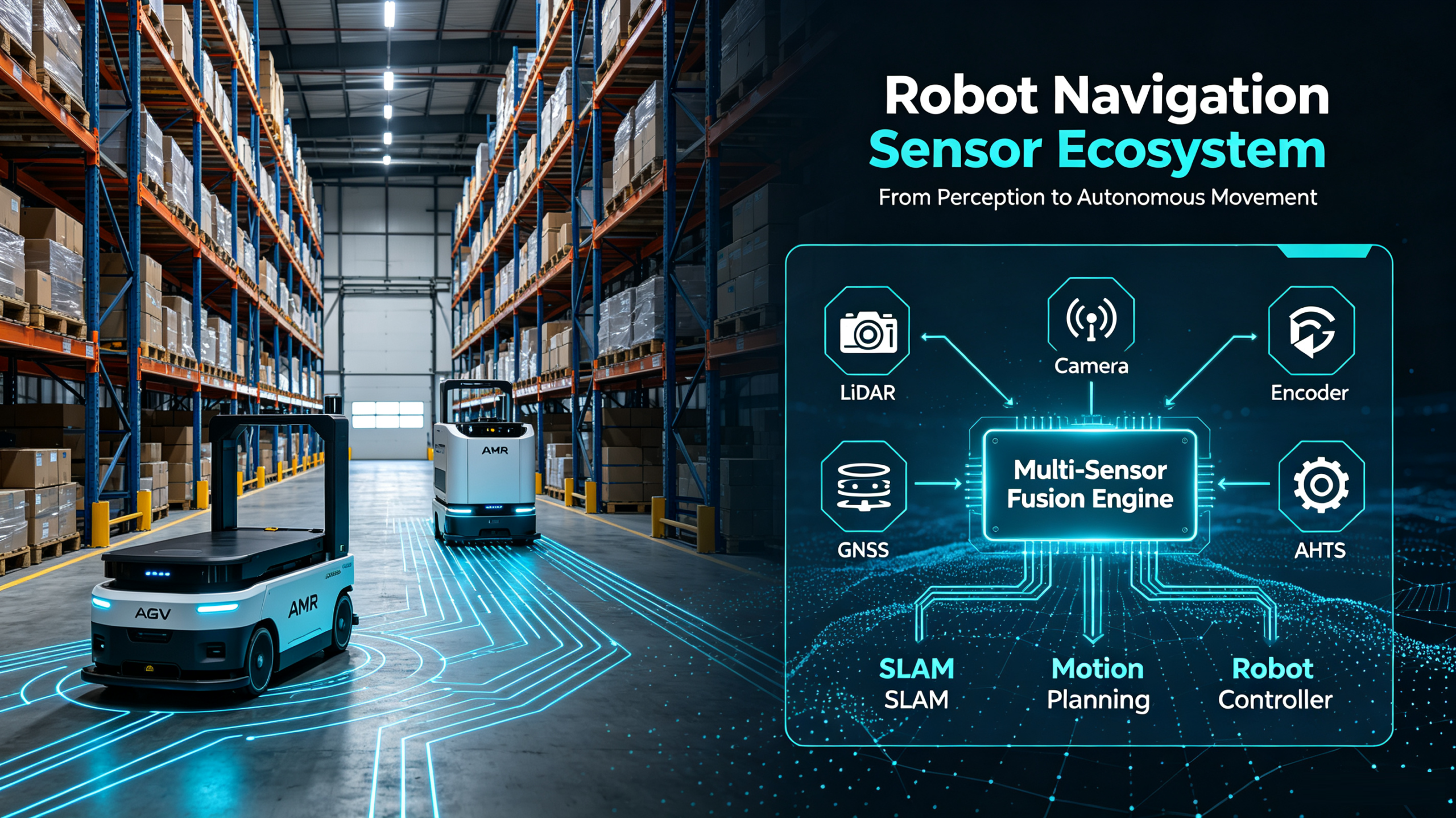
Modern robots never use a single positioning sensor alone. Most navigation systems fuse LiDAR, cameras, GNSS, wheel encoders and inertial data together, with AHRS for Robotics acting as the critical orientation backbone.
Your chosen
Robot Navigation Sensor must maintain steady output in GNSS-denied environments, such as warehouses, tunnels and underground mines where satellite signals are blocked. Standard
Mobile Robot IMU without onboard fusion cannot fill this gap reliably.
Without steady roll, pitch and heading data from professional Industrial AHRS, localization precision will drop sharply in indoor or enclosed industrial scenes.
3. Support Precise Closed-Loop Motion Control
Motion controllers need real-time error feedback to finish acceleration, turning and stopping smoothly this feedback comes entirely from your installed Robot AHRS.
The controller compares target posture with measured attitude data from the
Attitude Sensor for Robot in every control cycle. This closed-loop feedback reduces trajectory overshoot and makes robot movement smoother, which is essential for material handling and precision inspection tasks relying on consistent
Robot Orientation Sensor readings.
4. Enhance Obstacle Avoidance and Environment Perception
LiDAR point clouds and camera visual data depend on correct sensor alignment calibrated via your Robotics AHRS. If attitude estimation drifts, perception sensors will misjudge obstacle positions.
Stable, low-latency output from quality AHRS for Robotics calibrates sensor alignment in real time. It improves the reliability of environmental perception and lowers collision risks in dynamic industrial workspaces.
How Industrial AHRS Works: Sensors & Signal Workflow for Robotics AHRS
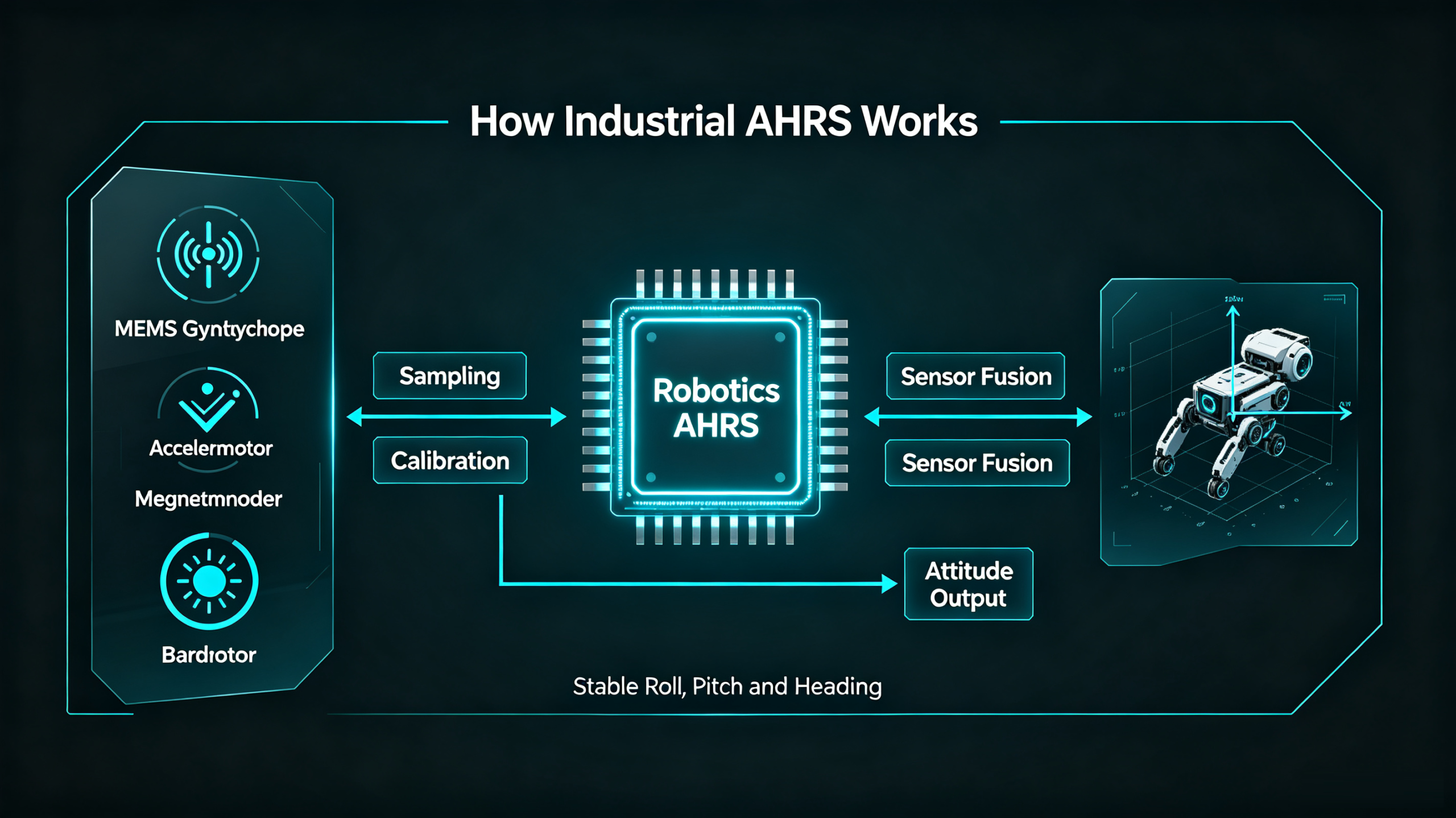
An Industrial AHRS is far more than a simple data collector for robotics teams. It runs a full loop of sampling, calibration, sensor fusion and attitude output hundreds of times per second, a capability that separates it from basic Mobile Robot IMU hardware.
The standard signal processing workflow of any professional Robot AHRS:
MEMS Gyroscope → MEMS Accelerometer → MEMS Magnetometer → Onboard Calibration → Sensor Fusion Algorithm → Roll/Pitch/Heading Output → Robot Controller → Motion Planning
Most commercial AHRS for Robotics support 100–200 Hz update rate. High refresh frequency ensures fast-moving robots obtain low-delay orientation data from their Robot Navigation Sensor to respond to terrain and motion changes immediately.
Four core MEMS sensors are integrated inside industrial-grade Attitude Sensor for Robot modules. Each has unique strengths and defects, which built-in fusion logic within the Robotics AHRS fully offsets.
MEMS Gyroscope
Three-axis gyroscopes measure angular velocity on X/Y/Z axes. It responds fastest to rapid rotation among all inertial sensors built into your Robot Orientation Sensor.
High-quality gyroscopes featured in ERICCO’s Industrial AHRS lines feature fast dynamic response, high sampling frequency and stable performance during sharp turns or rapid acceleration.
ERICCO ER-AHRS-5 and ER-AHRS-7 adopt industrial MEMS gyroscopes with key indicators:
- Bias instability ≤3°/h
- Angle random walk ≤0.21°/√h
- Measurement range ±2000°/s
These parameters guarantee stable attitude tracking even under aggressive robot motion. The only weakness of gyroscopes is long-term bias drift, which dedicated fusion algorithms inside your Robot AHRS automatically compensate for over extended operation.
MEMS Accelerometer
The accelerometer measures linear acceleration and Earth gravity simultaneously. Gravity provides a long-term stable reference to calculate roll and pitch angles for your Attitude Sensor for Robot.
Its obvious flaw is sensitivity to mechanical vibration and transient acceleration. Engineers solve this problem by fusing accelerometer gravity data with fast gyro rotational data native to every complete AHRS for Robotics.
Three-Axis Magnetometer
Magnetometers measure geomagnetic fields to calculate absolute heading, solving gyro long-term drift problems that plague unprocessed Mobile Robot IMU hardware.
However, indoor factories contain massive magnetic interference sources: steel frames, motors, transformers and power cables. These devices distort local magnetic fields and reduce heading accuracy from your Robot Navigation Sensor.
Premium Industrial AHRS embeds professional magnetic calibration algorithms, paired with magnetometers supporting ±800 μT measuring range. It effectively compensates magnetic distortion in factory environments for consistent Robot Orientation Sensor performance.
Integrated Barometric Pressure Sensor
Many advanced Robotics AHRS add a high-resolution 24-bit barometer, originally designed for UAVs but extremely valuable for ground mobile robot fleets.
For robots working on multi-layer warehouses, mines or steep slopes, barometers offer altitude reference. ERICCO’s flagship AHRS for Robotics barometric sensors achieve around 10 cm vertical resolution. Fusing barometer data with inertial information greatly optimizes vertical position estimation from your Robot AHRS.
Sensor Fusion: The Core Algorithm of Every Robot AHRS
No single sensor can provide perfect orientation data in all working conditions. The tradeoffs of each component inside your Attitude Sensor for Robot are summarized below:
| Sensor |
Core Advantage |
Main Limitation |
| Gyroscope |
Ultra-fast dynamic response |
Long-term bias drift |
| Accelerometer |
Stable gravity reference for roll/pitch |
Susceptible to vibration noise |
| Magnetometer |
Absolute directional reference |
Vulnerable to magnetic interference |
Sensor fusion algorithms balance multi-sensor data, filter noise and compensate drift to generate unified stable attitude output — this processing power is the key difference between a raw Mobile Robot IMU and finished Industrial AHRS.
Three mainstream algorithms are widely used for AHRS for Robotics: Complementary Filter, Kalman Filter and Extended Kalman Filter (EKF).
EKF fusion fits robotic scenarios best. It performs well under nonlinear movement, sudden acceleration and complex maneuvers. Meanwhile, EKF can seamlessly connect wheel encoders, LiDAR, stereo cameras and visual SLAM to build a complete autonomous navigation framework centered on your primary Robot Navigation Sensor.
Robotics AHRS in Multi-Sensor Navigation & SLAM Systems
A standalone Robot AHRS can output attitude independently, yet all high-performance autonomous robots operate under full multi-sensor fusion architecture. In this system, your Industrial AHRS serves as the unified orientation benchmark to align all perception sensors on the platform.
Every auxiliary navigation sensor has obvious limitations, which your core Robot Orientation Sensor makes up for:
- LiDAR: Accurate mapping, cannot measure rotation
- Cameras: Rich visual information, affected by light and weather
- Wheel encoders: Calculate travel distance, accumulate error from wheel slip
- GNSS: Global positioning, fails indoors or underground
A typical industrial robot navigation pipeline runs in this order, with AHRS for Robotics as a mandatory input:
LiDAR, Camera, GNSS, Encoder, Robotics AHRS → Multi-sensor Fusion Engine → SLAM Localization & Mapping → Motion Planning → Robot Controller
Your chosen Attitude Sensor for Robot is one of the few sensors that output continuous orientation without relying on light or satellite signals. It becomes a mandatory component for stable industrial robot navigation that no basic Mobile Robot IMU can replicate.
How Robot AHRS Optimizes SLAM Mapping Accuracy
Simultaneous Localization and Mapping (SLAM) is the core localization technology for warehouse, tunnel and mine robots without pre-laid beacons. LiDAR SLAM, visual SLAM and visual-inertial SLAM all rely heavily on high-precision data from your Robot Navigation Sensor.
Without real-time attitude feedback from calibrated Industrial AHRS, rotational drift accumulates rapidly, distorting map structure and reducing localization precision far faster than systems equipped with professional AHRS for Robotics.
A quality Robotics AHRS brings multiple measurable improvements to SLAM performance:
- Improve overall map consistency via stable Robot Orientation Sensor readings
- Reduce cumulative rotational drift during long mapping cycles
- Raise loop closure matching accuracy for warehouse and underground deployments
- Stabilize spatial alignment of all on-board perception sensors
- Maintain navigation reliability in fully GNSS-free environments
For fully indoor and underground robots, combining SLAM with robust Robot AHRS forms a self-contained navigation solution unaffected by satellite signal loss.
Typical Robotic Application Scenarios for Industrial AHRS
AHRS for Robotics hardware is widely used across all mainstream autonomous robot types. Each platform puts forward differentiated performance demands on your selected Attitude Sensor for Robot.
AGVs (Automated Guided Vehicles)
AGVs are core transport equipment in warehouses and production plants, running on fixed pre-planned routes.
Precise heading data from your installed Robot AHRS reduces directional drift during repeated operation. It ensures stable lane alignment, smooth turning and high-precision docking at loading stations, lowering collision risks and maintenance frequency for fleet-wide Industrial AHRS deployments.
AMRs (Autonomous Mobile Robots)
Different from fixed-path AGVs, AMRs rely on real-time environment perception to adjust routes dynamically to avoid obstacles, workers and changed layouts.
Continuous stable orientation data from dedicated Robotics AHRS supports AMR localization, obstacle detection and motion control. Without high-frequency output from a quality Robot Navigation Sensor, AMR path tracking will jitter and collision detection reliability drops significantly.
Humanoid Robots
Humanoid robots face strict balance control challenges during walking, stair climbing and human interaction. Tiny attitude errors will destroy gait stability directly without a responsive Robot Orientation Sensor.
High-precision AHRS for Robotics enables humanoid robots to realize:
- Dynamic balance maintenance via real-time Attitude Sensor for Robot feedback
- Stable walking locomotion across uneven floors
- Quick body tilt detection for safety cutoffs
- Instant response to external impact
This capability is critical for service robots that frequently interact with human staff in commercial spaces.
Quadruped Inspection Robots
Legged quadruped robots move on unstructured, uneven terrain such as factory pipelines, mine ground and outdoor power facilities. Their body roll and pitch change constantly during movement, demanding constant refresh from Industrial AHRS.
Real-time attitude data from your Robot AHRS transmits to leg coordination control modules. The controller adjusts each leg’s movement separately to keep the robot stable during inspection missions, making purpose-built Robotics AHRS essential for rugged legged inspection platforms.
Industrial Inspection Robots
Inspection robots work in the harshest industrial scenes: power stations, oil refineries, mine tunnels and underground pipelines. These sites are full of vibration, uneven ground and electromagnetic interference that degrade cheap Mobile Robot IMU performance.
Ruggedized Industrial AHRS guarantees stable navigation accuracy for long shifts. It keeps on-board thermal cameras, optical sensors and LiDAR aligned properly, ensuring complete undistorted inspection data collection supported by consistent Robot Orientation Sensor output.
Key Metrics to Select Industrial-Grade AHRS for Robotics
Engineers cannot choose their Robot AHRS only by a single accuracy parameter. They need to evaluate a full set of performance, environmental and integration indicators matching project requirements for your target Attitude Sensor for Robot.
1. Attitude Accuracy
Different applications have distinct accuracy thresholds for your core Robot Navigation Sensor:
- Ordinary warehouse AGVs: Allow around 1° heading error from standard Industrial AHRS
- Precision inspection, mapping and humanoid robots: Require 0.3° roll/pitch accuracy and better than 0.5° heading accuracy from premium AHRS for Robotics
ERICCO’s two flagship Robotics AHRS split product positioning strictly by heading precision:
- ER-AHRS-5: Heading accuracy <0.5°, ideal high-end Attitude Sensor for Robot for precision mapping and inspection
- ER-AHRS-7: Heading accuracy <1°, cost-effective Robot AHRS for standard AGV/AMR factory automation fleets
2. Update Rate
Dynamic fast-moving robots demand high refresh frequency attitude output from their Robot Orientation Sensor. Both ER-AHRS-5 and ER-AHRS-7 support 200 Hz output rate, the industry standard for reliable AHRS for Robotics.
High update rate shortens control loop delay, generates smoother robot movement and speeds up obstacle response. Low-frequency hardware or unprocessed Mobile Robot IMU will cause motion jitter and delayed collision avoidance.
3. Environmental Adaptability
Industrial robots often work under extreme conditions: sharp temperature changes, continuous vibration, dust, high humidity and electromagnetic interference that break down consumer-grade inertial hardware.
Professional Industrial AHRS adopts reinforced packaging, built-in temperature compensation and anti-vibration sensor layout to stabilize year-round performance. ERICCO two models support -40°C ~ +80°C wide temperature range, adapting to indoor factory and outdoor field robot deployments where cheaper Mobile Robot IMU fails.
4. Communication Interfaces
Easy system integration requires your chosen Robot AHRS to match mainstream industrial communication protocols of robot controllers and PLCs. ER-AHRS series support RS232, RS422 and CAN Bus for universal Robotics AHRS integration.
CAN Bus has become the most popular interface in modern robotics for its strong anti-interference and real-time transmission capacity. RS232/422 are reserved for legacy automation equipment relying on a dependable Attitude Sensor for Robot.
ERICCO ER-AHRS-5 vs ER-AHRS-7 Full Specification Table
| Specification |
ER-AHRS-5 (Premium AHRS for Robotics) |
ER-AHRS-7 (Cost-Balanced Robot AHRS) |
| Sensor architecture |
10-axis MEMS Industrial AHRS |
10-axis MEMS Industrial AHRS |
| Roll static accuracy |
0.3° Attitude Sensor for Robot |
0.3° Attitude Sensor for Robot |
| Pitch static accuracy |
0.3° |
0.3° |
| Heading static accuracy |
<0.5° Robot Orientation Sensor |
<1° Robot Orientation Sensor |
| Gyro bias instability |
≤3°/h |
≤3°/h |
| Angle random walk |
≤0.21°/√h |
≤0.21°/√h |
| Output update rate |
200 Hz Robot Navigation Sensor |
200 Hz Robot Navigation Sensor |
| Interfaces |
RS232 / RS422 / CAN |
RS232 / RS422 / CAN |
| Operating temperature |
-40°C ~ +80°C |
-40°C ~ +80°C |
Selection suggestions for your next AHRS for Robotics project:
- Choose ER-AHRS-5: Precision inspection, high-precision mapping, advanced humanoid robots requiring top-tier Robot Orientation Sensor performance
- Choose ER-AHRS-7: Standard AGVs, warehouse AMRs, general factory automation seeking affordable Industrial AHRS
In hardware selection, developers should judge the whole sensing system instead of focusing on isolated accuracy values of any single Mobile Robot IMU or Robotics AHRS. Early matching of proper industrial-grade Robot AHRS simplifies software development and improves long-term operation stability in complex real environments.
Mobile Robot IMU vs Industrial AHRS: Clear Functional Comparison for Engineers
Hardware designers frequently struggle with a basic critical question: pick a raw Mobile Robot IMU or finished AHRS for Robotics for robotic navigation projects?
Though they share similar inertial sensor hardware, their core functions, output data and applicable scenarios differ greatly for teams sourcing a reliable Robot Navigation Sensor.
Basic Definition of Mobile Robot IMU
A standard Mobile Robot IMU contains MEMS gyroscopes and accelerometers; magnetometers are optional extra accessories. It has zero embedded sensor fusion algorithms onboard.
A standalone IMU only outputs unprocessed raw sensor data. The robot’s navigation computer must finish all calibration, fusion and attitude calculation work through self-developed code a massive development overhead avoided with turnkey Robot AHRS.
Basic Definition of Robot AHRS / Industrial AHRS
Robot AHRS is built entirely on Mobile Robot IMU hardware foundation, with dedicated on-board processors running pre-optimized fusion algorithms unique to professional Industrial AHRS.
Instead of raw sensor signals, quality AHRS for Robotics directly outputs calibrated roll, pitch and heading angles that can be sent to motion controllers for immediate use as your primary Attitude Sensor for Robot.
This functional difference greatly reduces software development burden, shortens R&D cycles and lowers system failure risks caused by unvalidated self-written fusion code from raw IMU datasets.
Feature Contrast Table: Mobile Robot IMU vs Industrial AHRS
| Feature |
Standalone Mobile Robot IMU |
Industrial AHRS / Robot AHRS |
| MEMS gyroscope |
Included |
Included |
| MEMS accelerometer |
Included |
Included |
| 3-axis magnetometer |
Optional add-on |
Standard built-in for full Robot Orientation Sensor functionality |
| Onboard sensor fusion |
No custom processing required from user |
Pre-programmed EKF fusion core for ready-to-use Robotics AHRS |
| Direct roll/pitch output |
No (raw data only) |
Yes, calibrated real-time Attitude Sensor for Robot readings |
| Direct heading output |
No (raw data only) |
Yes, calibrated real-time Robot Navigation Sensor data |
| Directly connect to motion controller |
No, extra heavy data processing required |
Yes, plug-and-play AHRS for Robotics integration |
Scenario Selection Advice
- Mobile Robot IMU: Suitable for academic research projects requiring fully customizable navigation algorithms. Researchers need raw sensor data to test self-designed fusion logic, with no requirement for production-ready Robot AHRS output.
- Industrial AHRS / AHRS for Robotics: The first choice for commercial industrial robots, AGVs, AMRs and service robots. It avoids massive algorithm development and verification work, delivering instant usable data from your core Robot Orientation Sensor.
Common Navigation Error Sources & Optimization Best Practices for Robot AHRS
Even top-tier Industrial AHRS cannot eliminate all positioning drift if mechanical and electrical system design has defects around your installed Attitude Sensor for Robot. Mastering error sources and corresponding solutions can greatly boost overall robot localization performance from your primary Robot Navigation Sensor.
1. Mechanical Vibration Interference
Robot motors, gearboxes and moving structures generate continuous vibration noise, which mainly distorts accelerometer readings and creates attitude bias in your Robot AHRS.
- Install dedicated vibration isolation brackets for your Robotics AHRS module
- Fix internal wiring tightly to avoid mechanical resonance near the Robot Orientation Sensor
- Do not mount your core AHRS for Robotics directly on high-vibration parts such as drive motors
2. Industrial Magnetic Disturbance
Steel structures, high-current cables, transformers and permanent magnets change local geomagnetic fields and reduce magnetometer heading precision from any Industrial AHRS.
Optimization methods to protect your Attitude Sensor for Robot:
- Complete full magnetometer calibration immediately after your Robot AHRS physical installation
- Keep the main Robotics AHRS unit away from high-amperage power lines
- Avoid mounting your core Robot Navigation Sensor near large permanent magnet assemblies
3. Wheel Slip Causing Odometry Drift
Wheel encoders calculate travel distance by wheel rotation. Wheel slip on slippery or uneven ground creates accumulated positioning error over time that even premium Mobile Robot IMU cannot correct alone.
Optimization method: Fuse wheel encoder data with continuous attitude and motion data from your primary AHRS for Robotics. The combined system compensates slip error and improves trajectory estimation during acceleration, braking and turning cycles.
4. MEMS Sensor Temperature Drift
All MEMS inertial sensors produce bias shift with temperature variation. Outdoor robots face wide temperature fluctuation from -40°C to +80°C that cripples uncalibrated Mobile Robot IMU hardware.
Commercial Industrial AHRS integrates multi-point temperature compensation calibration models to automatically counteract thermal drift within your Robot AHRS. Low-cost consumer IMUs lack this function and will generate severe attitude deviation under temperature changes.
5. Sensor Coordinate Misalignment
Minor angle offset during your Robotics AHRS installation will bring permanent systematic attitude error and degrade mapping accuracy from your Robot Orientation Sensor.
Installation standards for every Attitude Sensor for Robot:
- Align the AHRS for Robotics coordinate axes completely with robot body frame
- Run post-installation axis calibration procedure after mounting your Robot AHRS
- Verify static attitude readings before formal field deployment of any Industrial AHRS
FAQ
Q: Does every mobile autonomous robot need a dedicated Robot AHRS?
A: Almost all self-driving robots gain obvious performance improvement from stable data supplied by AHRS for Robotics, acting as their core Robot Navigation Sensor for navigation and balance control. Only simple manually remote-controlled robots without autonomous navigation can skip deploying an Industrial AHRS or professional Attitude Sensor for Robot.
Q: Can Robotics AHRS improve SLAM mapping accuracy?
A: Yes. Real-time orientation data from calibrated Robot AHRS reduces cumulative rotational drift, optimizes map consistency, lifts loop closure success rate and stabilizes localization in indoor and underground GNSS-free scenes where a basic Mobile Robot IMU falls short.
Q: Is Industrial AHRS universally better than Mobile Robot IMU in all cases?
A: Neither hardware outperforms the other in every scenario. A raw Mobile Robot IMU provides unprocessed sensor data for customized research algorithms, while turnkey AHRS for Robotics outputs ready-to-use attitude angles to speed up commercial robot development. Industrial automation projects prioritize purpose-built Robot AHRS in nearly all production deployments.
Q: Can Robot AHRS work normally inside warehouses without GNSS signals?
A: Absolutely. Every professional Robotics AHRS relies on built-in inertial and magnetic sensors to generate attitude data and does not require satellite positioning. It acts as the primary Robot Orientation Sensor for all fully indoor robotic systems, outperforming standalone Mobile Robot IMU.
Q: Can AHRS for Robotics replace LiDAR for environmental detection?
A: No. A standard Robot AHRS only measures robot three-dimensional orientation angles as an Attitude Sensor for Robot. LiDAR captures surrounding obstacle geometric information. The two sensor types are complementary and cannot substitute each other within your full Robot Navigation Sensor stack.
Q: How often does Industrial AHRS need recalibration?
A: Full multi-sensor calibration must be executed after each Robot AHRS installation or repositioning of your core Robot Orientation Sensor. Regular calibration inspection during robot maintenance is enough for stable long-term operation of your AHRS for Robotics under unchanged environmental conditions.
Q: Which communication interface is most widely used for Robotics AHRS integration?
A: CAN Bus dominates modern autonomous robot deployments for Industrial AHRS, thanks to its outstanding real-time performance and anti-electromagnetic interference ability. RS232 and RS422 are reserved for older automation equipment requiring a dependable Attitude Sensor for Robot.
Q: What accuracy standard fits general industrial Robot AHRS hardware?
A: Ordinary AGV and AMR require around 0.3° static roll/pitch accuracy from their core Robot Navigation Sensor. Precision mapping, inspection and humanoid robots additionally need heading accuracy better than 0.5° from high-grade AHRS for Robotics.
Conclusion
As autonomous robots move toward full unmanned operation, high-performance sensing hardware becomes the unshakable foundation of reliable navigation and control software — and the most critical sensing component is a calibrated Robot AHRS.
Among all positioning and perception sensors integrated on mobile platforms, AHRS for Robotics occupies an irreplaceable core position as your primary Robot Orientation Sensor. It supplies stable roll, pitch and heading data to support localization algorithms, closed-loop motion control, multi-sensor fusion and safe autonomous navigation across various complex industrial environments.
No matter warehouse AGVs, terrain-adaptive quadruped inspection robots or interactive humanoid service platforms, rugged Industrial AHRS maintains stable posture and precise orientation tracking under constantly changing dynamic conditions a capability no unprocessed Mobile Robot IMU can match without extensive custom software work.
ERICCO ER-AHRS-5 and ER-AHRS-7 integrate high-precision calibrated MEMS sensors, optimized EKF fusion algorithms, universal industrial communication ports and wide-temperature rugged packaging. These flagship Robotics AHRS units fully satisfy strict performance requirements of modern industrial robot development teams sourcing a reliable Attitude Sensor for Robot.
With continuous robotics industry evolution, selecting matched AHRS for Robotics is no longer a trivial sensor purchasing decision. It is a core strategic design choice that directly determines navigation precision, dynamic stability and long-term field reliability of your autonomous robot fleet’s primary Robot Navigation Sensor.
For engineers evaluating inertial sensing solutions for new robotic projects, ERICCO full-series industrial-grade Robot AHRS deliver calibrated high-accuracy attitude measurement, low-latency output, strong environmental resistance and flexible multi-protocol communication interfaces.
These professional Industrial AHRS inertial sensors shorten product R&D cycles and improve overall autonomous system stability, covering AGVs, AMRs, humanoid robots, quadruped inspection platforms and outdoor autonomous monitoring equipment. Robotics development teams with customized performance requirements for their Robot Orientation Sensor can consult ERICCO’s professional engineering team to select the most suitable AHRS for Robotics hardware for their autonomous robot projects.
Post Views: 57