

Quick Answer
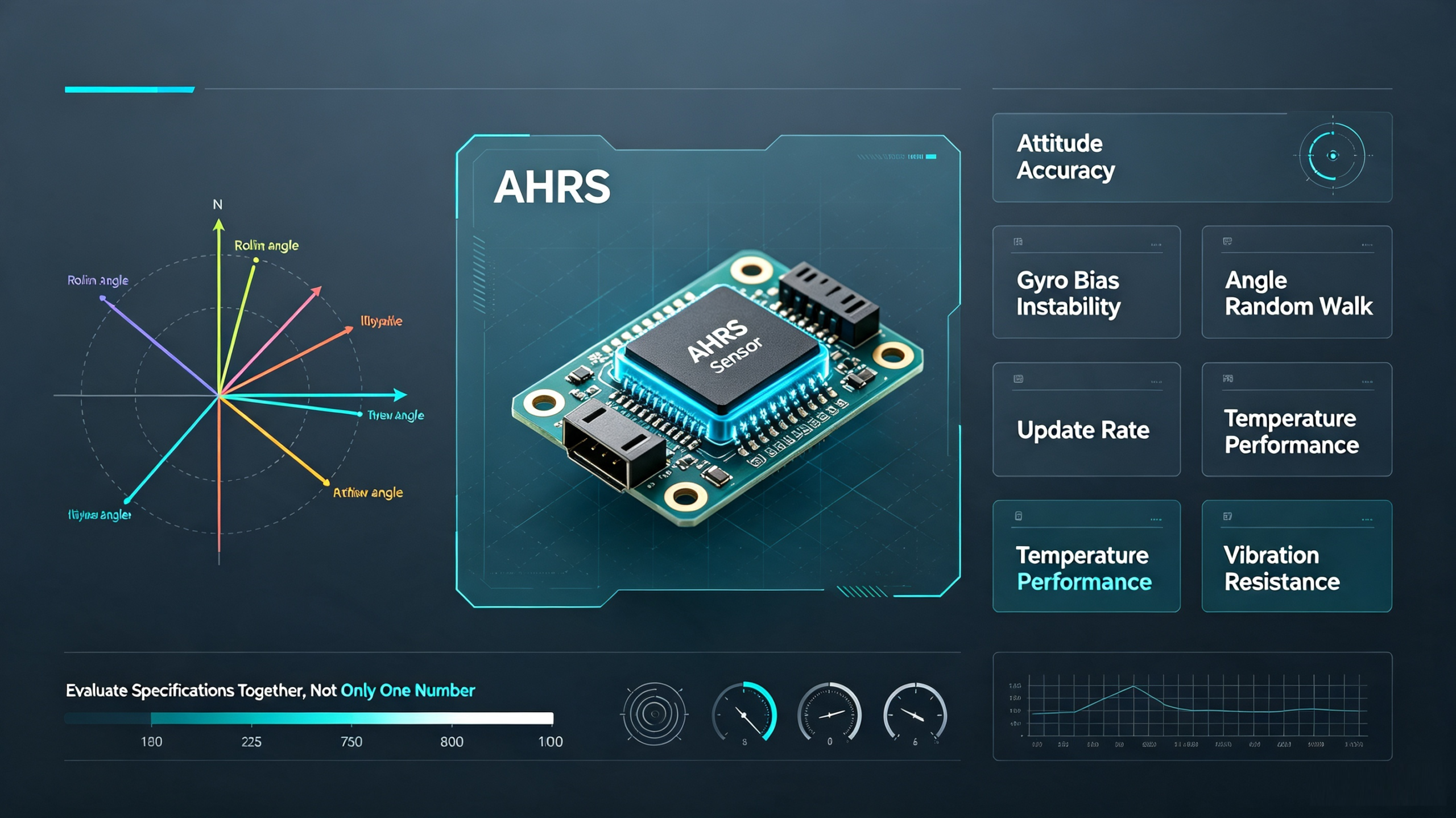
Choosing the right AHRS (Attitude and Heading Reference System) depends on more than attitude accuracy alone. Engineers should evaluate attitude accuracy, heading accuracy, gyroscope bias instability, angle random walk, measurement range, update rate, temperature performance, vibration resistance, communication interfaces, power consumption, size, and the requirements of the final application.
For general industrial applications, a cost-effective MEMS AHRS may provide the best balance between accuracy, size, power consumption, and integration cost. More demanding applications may require lower sensor drift, better dynamic performance, or a FOG-based attitude reference system.
The key principle is simple:
Choose an AHRS based on the actual performance requirements of the application, not simply the highest specification available.
Key Takeaways
- AHRS selection should begin with application requirements rather than product price.
- Roll, pitch, and heading accuracy should be evaluated separately.
- Gyroscope bias instability and Angle Random Walk strongly affect long-term attitude performance.
- Update rate and bandwidth are particularly important for dynamic platforms.
- Temperature, vibration, shock, and electromagnetic interference can significantly affect real-world AHRS performance.
- Communication interfaces, size, weight, and power consumption directly affect system integration.
- A MEMS AHRS is often sufficient for UAVs, robots, AGVs, vehicles, and industrial automation.
- Higher-end applications may require a more sophisticated inertial or FOG-based solution.
- ERICCO provides AHRS solutions ranging from compact MEMS systems to higher-performance inertial platforms.
Introduction
Modern autonomous systems increasingly depend on accurate attitude information.
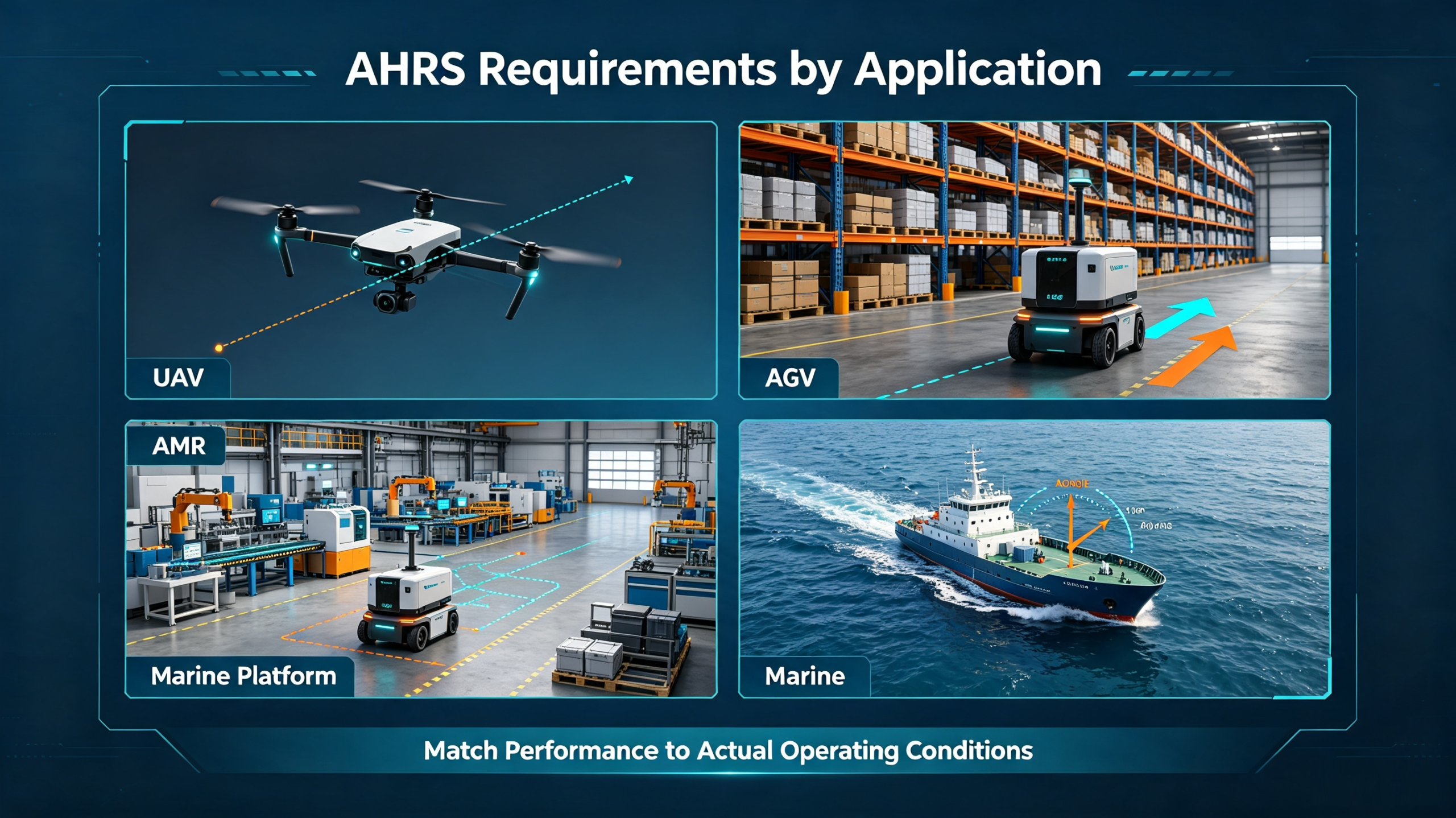
A UAV needs to know whether it is rolling, pitching, or changing heading. An autonomous vehicle needs stable orientation information while turning or accelerating. A mobile robot needs to estimate its body orientation while navigating around obstacles. Marine platforms require reliable heading and attitude information even when external positioning information becomes unreliable.
An AHRS provides this orientation information by combining inertial sensors and sensor-fusion algorithms.
However, choosing an AHRS for an industrial project is not always straightforward.
Two products may both be described as "high-accuracy AHRS" while having significantly different performance characteristics. One may provide better heading accuracy, another may have lower gyroscope drift, while a third may offer better vibration resistance or easier system integration.
Therefore, the correct question is not:
"What is the most accurate AHRS?"
Instead, engineers should ask:
"What AHRS performance does my application actually require?"
This guide provides a practical framework for answering that question.
What Specifications Matter When Choosing an AHRS?
1. Attitude Accuracy
The first specification to evaluate is attitude accuracy.
An AHRS normally provides:
- Roll
- Pitch
- Heading or yaw
However, these three measurements do not necessarily have identical accuracy.
For example, an AHRS may provide excellent roll and pitch accuracy while heading accuracy is comparatively lower.
This distinction is important because different applications prioritize different measurements.
UAVs
Flight-control systems may place greater emphasis on rapid and stable roll and pitch measurements.
Robotics
Humanoid and mobile robots may require stable attitude information during dynamic movement.
Marine Navigation
Heading accuracy can become particularly important for vessel control and directional stabilization.
Mapping
Small attitude errors can affect the orientation of LiDAR or imaging sensors and consequently influence mapping accuracy.
Therefore, engineers should always evaluate roll accuracy, pitch accuracy, and heading accuracy separately.
2. Gyroscope Bias Instability
Gyroscope bias instability is one of the most important specifications when evaluating an industrial AHRS.
A gyroscope does not output exactly zero when the system is stationary. A small residual bias exists, and changes in this bias can contribute to attitude drift over time.
Lower bias instability generally means better long-term stability.
ERICCO ER-AHRS-5 and ER-AHRS-7 both specify a gyroscope bias instability of ≤3°/h, placing them in a useful performance range for many industrial attitude-reference applications.
This specification should be considered alongside the application's operating time.
For a system that only requires short-duration attitude stabilization, extremely low drift may not be necessary.
For long-duration autonomous operation, however, gyroscope stability becomes much more important.
3. Angle Random Walk
Angle Random Walk (ARW) describes an important component of gyroscope noise.
Lower ARW generally means lower short-term angular measurement noise.
This becomes important when an AHRS is used in:
- Autonomous vehicles
- UAV flight control
- Robotic motion control
- Mobile mapping
- Stabilization platforms
For example, ER-AHRS-7 specifies a gyroscope Angle Random Walk of ≤0.21°/√h, together with a rate noise density of 5 mdps/√Hz.
When comparing two AHRS products, engineers should avoid looking at bias instability alone. Bias stability describes one aspect of long-term performance, while ARW and noise density provide additional information about short-term measurement behavior.
4. Measurement Range
The measurement range should match the maximum dynamics of the platform.
If the maximum angular velocity of a robot, UAV, or vehicle exceeds the gyroscope's measurement range, the sensor can saturate and produce invalid measurements.
For example, ER-AHRS-7 supports selectable gyroscope ranges of:
- ±125°/s
- ±500°/s
- ±1000°/s
- ±2000°/s
according to the published product specifications.
The appropriate range depends on the application.
A slow-moving industrial platform does not necessarily benefit from selecting the maximum range.
Conversely, a highly dynamic UAV or robotic platform may require a wider measurement range to prevent saturation during rapid rotation.
5. Update Rate and Bandwidth
An AHRS can be highly accurate but still unsuitable for a fast-moving control system if its output rate or response characteristics do not match the controller.
Higher update rates provide more frequent attitude information for the control system.
For many industrial systems, common update rates include:
- 100 Hz
- 200 Hz
- 500 Hz
ERICCO's ER-AHRS-5 and ER-AHRS-7 are specified with 200 Hz output, providing a practical data rate for many UAV, robotic, vehicle, and industrial control applications.
However, engineers should distinguish between output rate and actual sensor bandwidth.
ER-AHRS-7, for example, specifies gyroscope and accelerometer bandwidth above 100 Hz.
Therefore, when evaluating an AHRS, check both parameters rather than assuming that a higher digital output rate automatically means better dynamic performance.
6. Temperature Performance
Temperature is one of the most common reasons why laboratory sensor performance differs from real-world performance.
Gyroscope and accelerometer parameters can change as temperature changes.
Important specifications include:
- Operating temperature
- Bias temperature coefficient
- Scale-factor temperature coefficient
- Factory temperature calibration
- Temperature compensation
ERICCO ER-AHRS-7 specifies an operating range of -40°C to +80°C in its product information and provides temperature-related sensor specifications, including a gyroscope angular-rate sensitivity temperature coefficient of ±70 ppm/°C and an accelerometer bias temperature coefficient of ±0.10 mg/°C.
This type of information is particularly important for:
- Outdoor robots
- UAVs
- Construction equipment
- Mining systems
- Marine equipment
- Industrial vehicles
A product's nominal accuracy at room temperature should never be the only criterion for an industrial application.
7. Vibration and Shock Resistance
Industrial robots, UAVs, vehicles, and machinery generate mechanical vibration.
Motors, gearboxes, propellers, wheels, tracks, and mechanical actuators can all introduce vibration into the inertial sensor.
Excessive vibration can increase sensor noise and affect attitude estimation.
Therefore, engineers should consider:
- Sensor mechanical design
- Mounting method
- Vibration environment
- Shock environment
- Filtering
- Dynamic compensation
For harsh applications, the AHRS should be evaluated under actual operating conditions rather than only under static laboratory conditions.
8. Communication Interface
A technically excellent AHRS can still create integration problems if its communication interface does not match the host system.
Common industrial interfaces include:
- RS232
- RS422
- CAN
- UART
- SPI
ERICCO's ER-AHRS-5 and ER-AHRS-7 provide optional RS422/RS232 and CAN interfaces, allowing integration into different industrial systems.
Before purchasing, engineers should confirm:
- Physical interface compatibility
- Data protocol
- Output frequency
- Data format
- Timing requirements
- Power requirements
This can prevent unnecessary hardware conversion or software redevelopment during system integration.
9. Size, Weight, and Power Consumption
For mobile platforms, physical specifications can be just as important as sensor accuracy.
UAVs, robots, handheld systems, and compact vehicles often have strict limits on:
- Weight
- Volume
- Power consumption
ERICCO's ER-AHRS-5, for example, has published dimensions of 40 × 40 × 24 mm, with power consumption of ≤0.5 W. It also accepts a 5–12 V input range.
These characteristics can simplify integration into space-constrained systems.
For a battery-powered platform, low power consumption can also extend operating time.
AHRS Requirements by Application
There is no universal AHRS specification that is ideal for every application.
The appropriate configuration depends on the platform's dynamics, environment, and accuracy requirements.
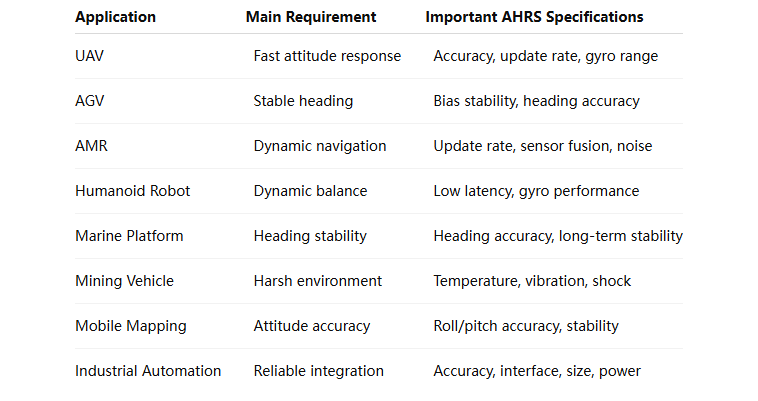
This is why product selection should always begin with the actual operating scenario.
AHRS vs IMU: Which Should You Choose?
An important purchasing decision is whether the system requires an AHRS or an IMU.
An IMU primarily provides inertial sensor measurements, while an AHRS processes sensor data and provides an attitude solution.
If your development team already has sophisticated navigation and sensor-fusion algorithms, an IMU may provide greater flexibility.
If you need a ready-to-use orientation output, an AHRS can significantly simplify integration.
In simple terms:
Choose an IMU when you want to develop the navigation solution yourself.
Choose an AHRS when you need a ready-to-use attitude solution.
For a deeper technical comparison, this article should internally link to your existing AHRS vs IMU article.
AHRS vs INS: When Do You Need an INS?
AHRS is primarily an attitude-reference solution.
An INS goes further by providing a navigation solution that can include:
- Position
- Velocity
- Attitude
Therefore, AHRS is generally appropriate when the primary requirement is orientation.
An INS is more appropriate when the application requires complete navigation information.
For example:
Attitude stabilization → AHRS
Position + velocity + attitude → INS
This distinction is especially important when designing UAV, marine, autonomous vehicle, and mapping systems.
ERICCO AHRS Solutions
ERICCO's current AHRS portfolio includes several solutions designed for different performance and application requirements. The company lists the ER-AHRS-5, ER-AHRS-7, and ER-AHRS-10 within its AHRS-related product portfolio.
ER-AHRS-5: High-Performance MEMS AHRS
The ER-AHRS-5 is a 10-axis attitude reference system integrating:
- 3-axis MEMS gyroscope
- 3-axis accelerometer
- 3-axis magnetometer
- Barometer
- Sensor filtering
- Data-fusion algorithms
The published specifications include:
- Roll accuracy: 0.3°
- Pitch accuracy: 0.3°
- Heading accuracy: <0.5°
- Gyroscope bias instability: ≤3°/h
- Angle Random Walk: ≤0.21°/√h
- Output rate: 200 Hz
- Static drift: 0.5°/10 min
- Power consumption: ≤0.5 W
- Operating temperature: -40°C to +80°C
- Size: 40 × 40 × 24 mm
The system also provides RS422/RS232 and CAN interface options.
These characteristics make the ER-AHRS-5 suitable for applications where compact size, low power consumption, and higher attitude/heading performance are important.
ER-AHRS-7: Cost-Effective Industrial AHRS
The ER-AHRS-7 is designed as a cost-effective 10-axis attitude reference system and integrates three-axis gyroscope, three-axis accelerometer, three-axis magnetometer, and barometer functions.
Its published specifications include:
- Roll/pitch accuracy: 0.3°
- Absolute heading accuracy: <1°
- Static roll/pitch drift: 0.5°/10 min
- Gyroscope bias instability: ≤3°/h
- Angle Random Walk: ≤0.21°/√h
- Gyroscope bandwidth: >100 Hz
- Accelerometer bandwidth: >100 Hz
- Magnetometer dynamic range: ±50 gauss
- Power consumption: ≤0.5 W
- Input voltage: 5–12 V
- Communication: RS232/RS422/CAN
- Operating temperature: -40°C to +80°C
The gyroscope measurement range can be configured from ±125°/s to ±2000°/s, while the accelerometer range can be configured from ±2 g to ±16 g.
This makes the ER-AHRS-7 particularly interesting for cost-sensitive industrial projects that still require a complete attitude and heading solution.
ER-AHRS-10: When a Different Performance Level Is Required
ERICCO also lists the ER-AHRS-10 platform, which uses industrial-grade inertial sensors and provides a 0.3° dynamic attitude accuracy according to the product page. The published information specifies gyroscope bias instability of 6°/h and accelerometer bias instability of 0.05 mg.
The ER-AHRS-10 family includes different configurations:
- ER-AHRS-10U: IMU
- ER-AHRS-10V: VRU
- ER-AHRS-10A: AHRS
This illustrates an important point in AHRS selection:
The correct product is determined by the required output and application, not simply by choosing the product with the most specifications.
Common AHRS Selection Mistakes
Mistake 1: Choosing Only by Accuracy
A single accuracy number does not describe complete AHRS performance.
Always evaluate:
- Roll
- Pitch
- Heading
- Bias stability
- Noise
- Dynamic behavior
Mistake 2: Ignoring the Operating Environment
An AHRS that performs well in a laboratory may behave differently in a high-vibration industrial environment.
Always evaluate temperature, vibration, shock, and electromagnetic interference.
Mistake 3: Selecting an Excessively High-Performance Product
Higher performance usually comes with higher cost and potentially greater system complexity.
If a warehouse AGV only requires stable heading and moderate attitude accuracy, an ultra-high-end inertial system may provide little practical benefit.
Mistake 4: Ignoring Integration Requirements
Check the interface, voltage, communication protocol, physical dimensions, mounting configuration, and software requirements before placing an order.
Mistake 5: Comparing Products Only by Price
The lowest purchase price does not necessarily mean the lowest system cost.
A sensor that requires extensive integration, calibration, filtering, or hardware modification may ultimately increase development costs.
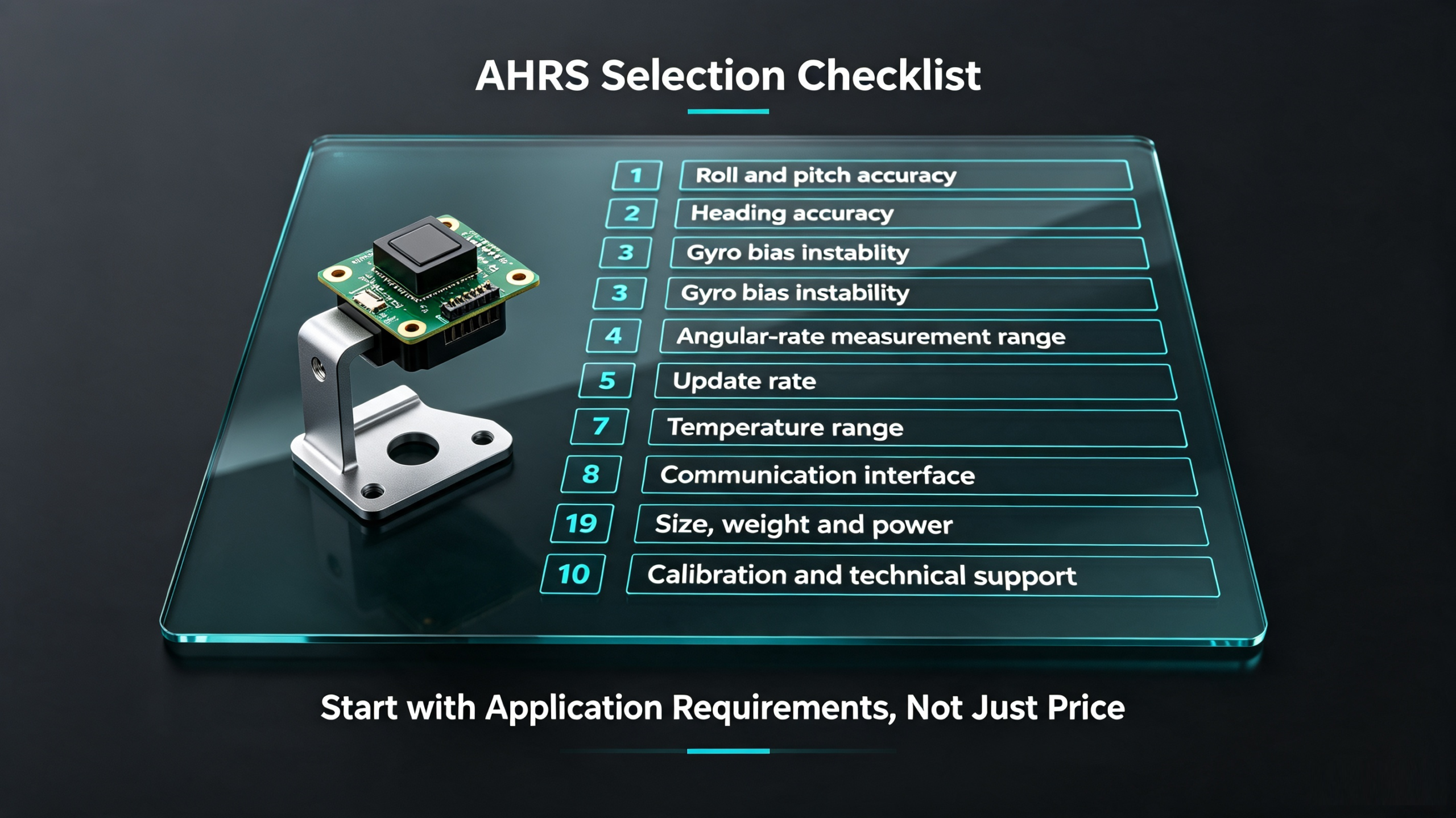
AHRS Selection Checklist
Before purchasing an AHRS, engineers should answer these ten questions:
1. What roll and pitch accuracy does the application require?
2. What heading accuracy is required?
3. What gyroscope bias instability is acceptable?
4. What angular-rate measurement range is necessary?
5. What update rate does the control system require?
6. What temperature range will the AHRS experience?
7. How much vibration and shock will the sensor experience?
8. Which communication interface does the host controller require?
9. What are the maximum size, weight, and power limits?
10. Can the supplier provide calibration, documentation, customization, and technical support?
If these ten questions are clearly answered, comparing AHRS products becomes significantly easier.
FAQ
Q: What is the most important specification when choosing an AHRS?
A: There is no single specification that is most important for every application. Accuracy, bias stability, update rate, measurement range, temperature performance, and environmental robustness should be evaluated together.
Q: What AHRS accuracy do I need for a UAV?
A: The required accuracy depends on the UAV's flight-control and navigation architecture. Highly dynamic or precision applications generally require better attitude and heading performance than basic stabilization systems.
Q: Is a higher AHRS update rate always better?
A: Not necessarily. The update rate should match the control loop and sensor dynamics. A high output rate does not automatically guarantee better attitude accuracy.
Q: Does temperature affect AHRS accuracy?
A: Yes. Temperature can change gyroscope bias, accelerometer bias, and scale factor. Temperature compensation and calibration are therefore important for industrial applications.
Q: Can an AHRS operate without GNSS?
A: Yes. An AHRS can calculate attitude using its internal inertial sensors and, where applicable, magnetic information. GNSS can provide additional navigation information but is not inherently required for AHRS attitude output.
Q: Should I choose an AHRS or an IMU?
A: Choose an AHRS when you want a ready-to-use attitude solution. Choose an IMU when you need raw inertial measurements and plan to develop your own sensor-fusion and navigation algorithms.
Q: Can an AHRS replace an INS?
A: Generally, no. An AHRS primarily provides orientation, while an INS provides a more complete navigation solution including position and velocity.
Conclusion
Choosing the right AHRS is ultimately an engineering trade-off between accuracy, stability, dynamics, environmental performance, integration requirements, and cost.
The best AHRS is not necessarily the product with the highest specification. It is the product whose performance matches the real requirements of the system.
For a UAV, update rate, attitude stability, and weight may be critical. For an AMR, heading stability and sensor fusion may be more important. For mining or construction equipment, temperature and vibration resistance can become major selection criteria. For mapping systems, attitude accuracy and long-term stability may have a direct impact on final measurement quality.
ERICCO's AHRS portfolio demonstrates how different inertial architectures can address different application requirements. The ER-AHRS-5 provides a compact, high-performance 10-axis MEMS solution, while the ER-AHRS-7 offers a cost-effective industrial alternative with configurable sensor ranges and multiple interfaces. The ER-AHRS-10 family provides additional IMU, VRU, and AHRS configurations for applications requiring different levels of inertial functionality.
For engineers evaluating an AHRS, the most effective approach is to define the application's requirements first and then compare products against those requirements.