

Quick Answer
A MEMS Gyroscope for Robotics is a compact inertial sensor that measures angular velocity around one or more axes, enabling robots to detect rotational motion with high speed and precision. As a core component of IMU and AHRS, it supports balance control, orientation estimation, and autonomous navigation. Combined with accelerometers, magnetometers, LiDAR, cameras, and wheel encoders via sensor fusion, it ensures reliable localization and stable motion even in GNSS‑denied environments.
Key Takeaways
-
A MEMS gyroscope measures angular velocity, essential for robot orientation and motion control.
-
It is a critical part of industrial IMUs and AHRS in autonomous systems.
-
Sensor fusion integrates gyro data with other sensors to reduce drift and improve accuracy.
-
Key specs bias instability, angle random walk (ARW) , bandwidth, and measurement range directly impact performance.
-
High‑performance industrial MEMS gyroscopes are used in AGVs, AMRs, humanoids, quadruped robots, inspection, and mining systems.
Introduction
Modern robotics demands reliable inertial sensing for dynamic navigation, obstacle avoidance, and precise manipulation. Unlike GNSS or vision, a MEMS gyroscope provides continuous rotational data irrespective of lighting, weather, or indoor/underground conditions. As robots become more autonomous, gyroscopes serve as the foundation for industrial IMUs and AHRS, ensuring stable operation in warehouses, factories, mines, and complex outdoor terrains.
What Is a MEMS Gyroscope?
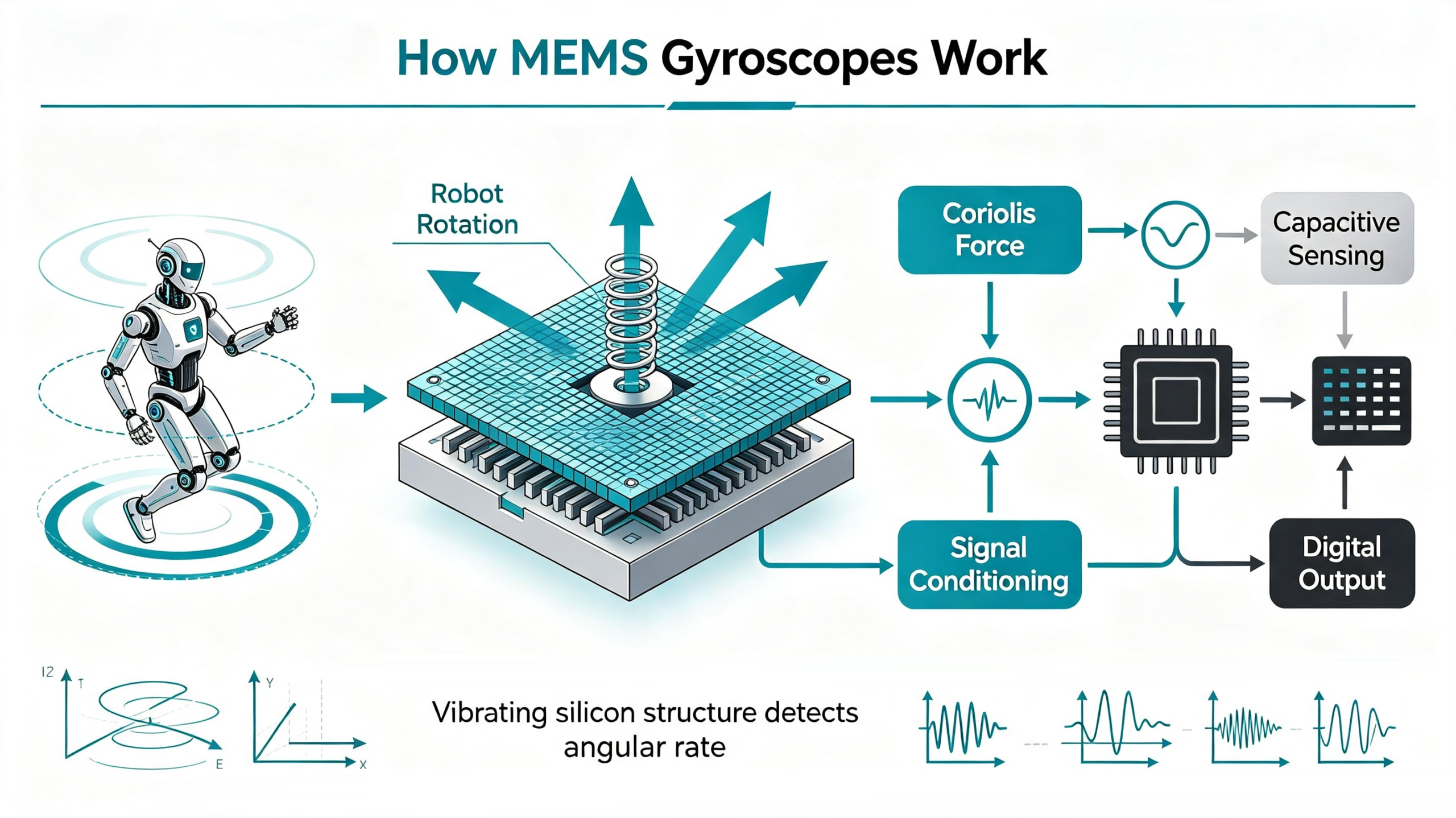
A Micro‑Electro‑Mechanical Systems (MEMS) gyroscope uses vibrating silicon structures to detect angular velocity via the Coriolis effect. Capacitive sensing converts mechanical displacement into digital signals. Advantages over traditional gyros include compact size, low power, high shock/vibration tolerance, and cost‑effective mass production.
Configurations: single‑axis (stabilization), dual‑axis (enhanced awareness), and three‑axis (roll/pitch/yaw) the latter being the standard for most robotic platforms.
How MEMS Gyroscopes Work
The operating sequence is:
Robot rotation → vibrating structure experiences Coriolis force → capacitive detection → signal conditioning → digital output.
The output is proportional to angular rate. However, all gyros suffer from long‑term drift, so industrial robots never rely solely on gyroscopes. Instead, data is fused with accelerometers, magnetometers, wheel encoders, LiDAR, and cameras to obtain a robust orientation estimate.
Why Robots Need MEMS Gyroscopes
Every robot must answer “How am I moving?” hundreds of times per second. MEMS gyroscopes provide the answer.
Dynamic Balance: Humanoids, quadrupeds, and legged robots need instant rotational feedback to adjust motor torques and avoid falls.: For wheeled robots, gyros improve stability during rapid acceleration, sharp turns, and ramp climbing.
Motion Estimation: Accurate angular velocity enables better trajectory prediction, smoother steering, and reduced navigation oscillations. This is critical for high‑speed AGVs and AMRs, where small heading errors accumulate over long distances.
Dead Reckoning: In GNSS‑denied environments (underground mines, tunnels, warehouses), robots rely on dead reckoning combining gyro, accelerometer, and encoder data. A low‑drift gyroscope significantly extends the reliable navigation period.
Autonomous Navigation: Gyroscopes support LiDAR point‑cloud alignment, visual‑inertial odometry (VIO), and SLAM by providing continuous orientation, making AI‑driven path planning more consistent.
Sensor Fusion: The Intelligence Layer
No single sensor is perfect: accelerometers sense vibration, magnetometers are disturbed by metals, encoders slip, cameras fail in poor light, and GNSS is unavailable indoors.
Sensor fusion algorithms (Complementary Filter, Kalman Filter, Extended Kalman Filter, Error‑State Kalman Filter) weigh each sensor’s strengths and produce a unified state estimate. This compensates drift, suppresses noise, and yields better localization, smoother control, and higher map consistency.
Key Performance Parameters for Industrial MEMS Gyroscopes
Choosing a gyroscope requires understanding these specs:
-
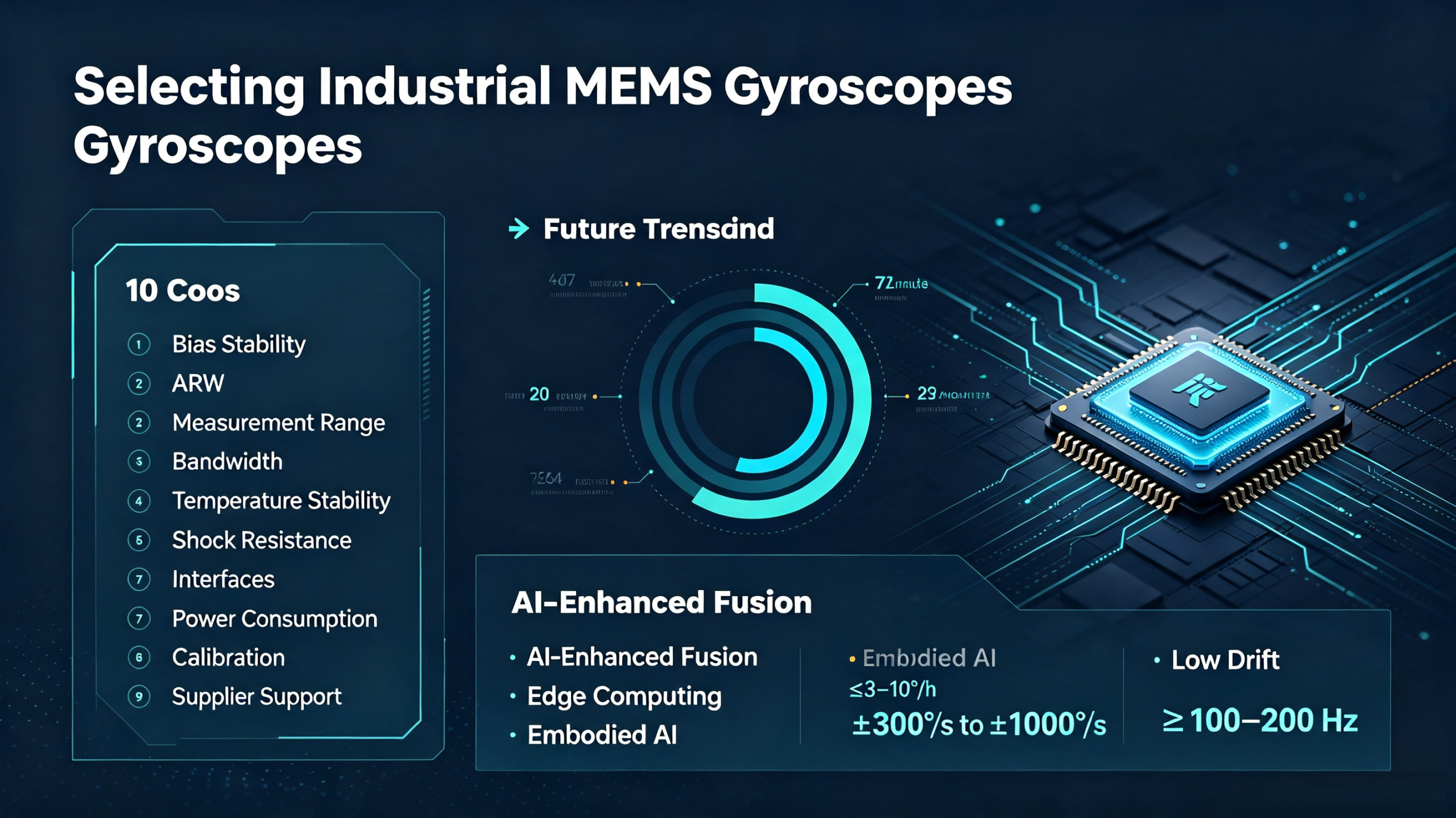
Bias Instability – the slow drift of zero‑rate output. Lower values (≤3‑10°/h) mean better heading accuracy over hours.
-
Angle Random Walk (ARW) – short‑term noise; lower ARW gives cleaner angular measurements and better fusion results.
-
Measurement Range – maximum detectable angular rate (e.g., ±300°/s to ±1000°/s). Must exceed the robot’s maximum turn rate.
-
Bandwidth & Update Rate – ≥100‑200 Hz for fast control loops; higher bandwidth reduces latency.
-
Temperature Stability – factory calibration and compensation ensure consistent performance across ‑40 to +85°C.
-
Shock/Vibration Resistance – industrial‑grade designs withstand motor vibrations and terrain impacts.
Requirements by Robot Type (Quick Reference)
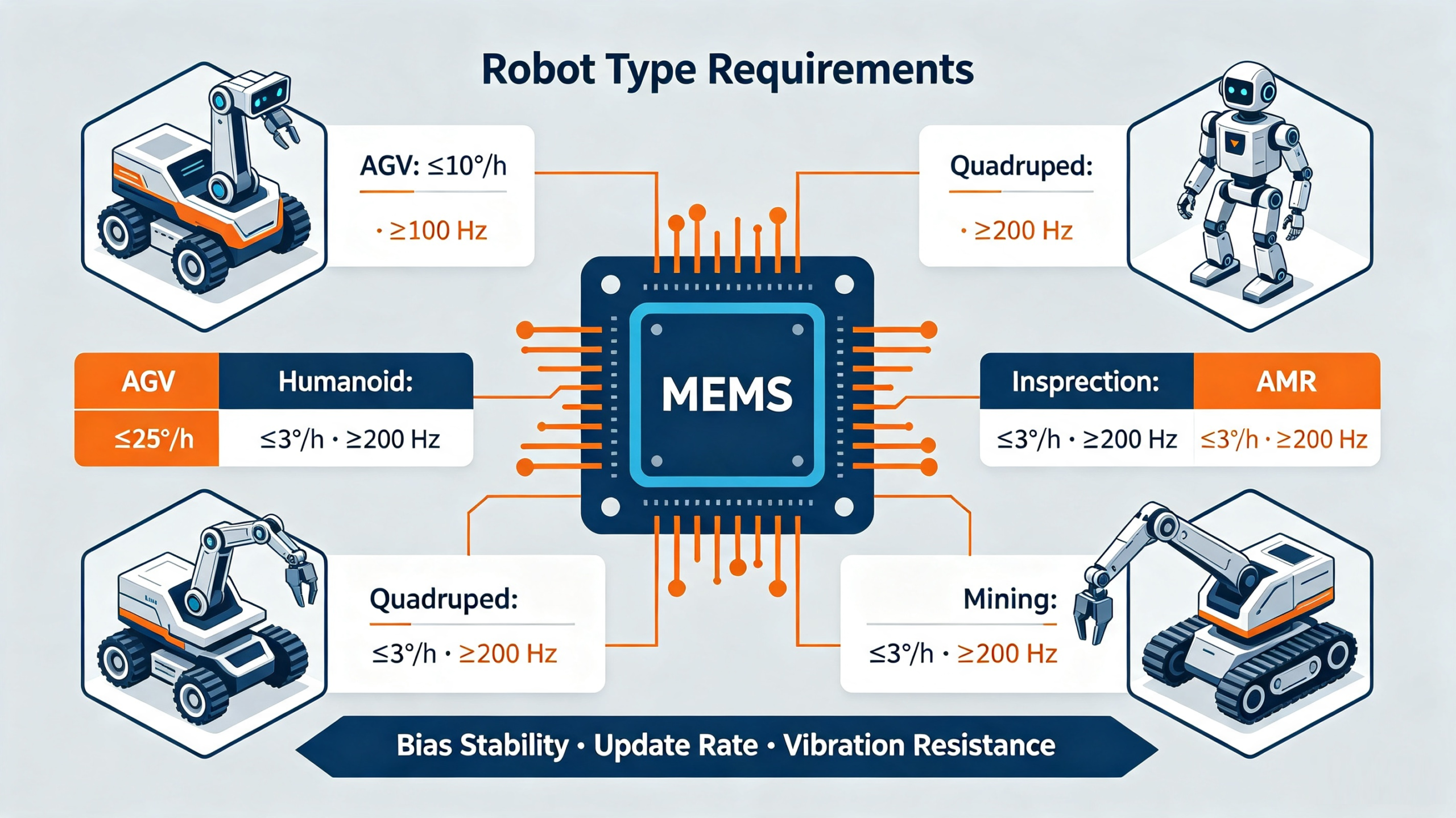
| Robot Type | Typical Use | Bias Stability | Update Rate | Priority |
|---|---|---|---|---|
| AGV | Warehousing | ≤10°/h | ≥100 Hz | Cost‑effective heading |
| AMR | Dynamic factories | ≤5°/h | ≥200 Hz | Low latency & fusion |
| Humanoid | Service, research | ≤3°/h | ≥200 Hz | Balance & posture |
| Quadruped | Inspection, rescue | ≤3°/h | ≥200 Hz | Vibration resistance |
| Inspection | Pipelines, power | ≤3°/h | ≥200 Hz | Long‑term stability |
| Mining | Underground | ≤3°/h | ≥200 Hz | Temperature & GNSS‑denied |
| Cobot | Precision assembly | ≤5°/h | ≥100 Hz | Smooth repeatability |
MEMS vs. Fiber Optic Gyroscope (FOG)
-
MEMS: compact, light, low power, cost‑effective, accuracy high (bias 1‑10°/h) – ideal for most robotics.
-
FOG: excellent bias stability (<0.1°/h), larger, heavier, higher cost – used in aerospace and marine INS.
For 90% of industrial robots, MEMS offers the best performance‑price trade‑off.
10‑Point Selection Checklist
-
Navigation accuracy: match bias stability and ARW to your application.
-
Measurement range: ensure no saturation during sharp turns.
-
Update rate & bandwidth: fast robots need ≥200 Hz.
-
Bias stability: lower drift for long‑duration dead reckoning.
-
ARW: lower noise for smooth fusion.
-
Environmental robustness: temperature, vibration, shock, EMC.
-
Communication interfaces: RS232, RS422, CAN, UART, SPI.
-
Power consumption: critical for battery‑powered platforms.
-
Calibration & compensation: factory‑calibrated sensors save engineering effort.
-
Supplier support: documentation, integration help, long‑term availability.
Industrial MEMS Gyroscope Solutions
Industrial robots demand higher reliability than consumer devices. Look for:
-
Stable bias over time
-
Low ARW
-
Wide temperature range
-
High vibration tolerance
-
Proven communication protocols
-
Consistent quality and calibration
Choosing an experienced inertial sensor supplier reduces integration risk and accelerates time‑to‑market.
Future Trends
-
Higher precision via advanced MEMS fabrication – bias instability approaching 1°/h or better.
-
AI‑enhanced fusion – machine learning for adaptive calibration and anomaly detection.
-
Edge computing – on‑chip processing reduces latency for real‑time control.
-
Embodied AI – next‑gen robots will demand even lower drift and higher update rates to support complex interactions.
FAQ
Can a robot navigate with only a MEMS gyro? No – it needs accelerometers, encoders, or vision for position.
Is MEMS gyro same as IMU? No – gyro is a sensor; IMU combines gyro + accelerometer (± magnetometer).
Why does bias instability matter? It determines heading drift over time – crucial for dead reckoning.
What is ARW? Short‑term noise; lower ARW improves fusion and SLAM.
Can MEMS gyros survive harsh environments? Yes – industrial‑grade models are built for shock, vibration, and wide temperatures.
How do gyros help SLAM? They provide continuous rotation estimates, reducing map distortion during motion.
Common interfaces? RS232, RS422, CAN, UART, SPI.
Calibration frequency? Factory calibrated; re‑calibration recommended after heavy use or extreme conditions.
Conclusion
MEMS gyroscopes are indispensable for modern robotics, enabling precise balance, motion estimation, and autonomous navigation. When combined with sensor fusion and other modalities, they deliver robust localization in challenging environments. Selecting the right gyro involves balancing bias stability, ARW, bandwidth, environmental ruggedness, and system cost. As robotics advances toward greater autonomy, high‑performance MEMS gyroscopes will remain a foundational technology for safer, smarter, and more efficient machines.