

Why Is Accurate Directional Measurement Important in Mining?
Directional drilling plays an important role in underground coal mining, gas drainage, water hazard prevention, geological exploration, and other subsurface engineering projects. As drilling operations become deeper and more complex, engineers need reliable information about borehole direction and tool orientation to evaluate whether drilling is following the planned trajectory.
However, underground environments present several challenges for conventional directional measurement equipment.
Metal structures, steel pipes, drilling equipment, and electrical machinery can create magnetic interference. This may affect sensors that rely on the Earth's magnetic field to determine direction. Meanwhile, drilling operations expose measurement instruments to mechanical vibration, impact, and temperature changes. Space limitations inside measurement probes create another challenge, particularly when the directional module must be installed in a narrow cylindrical housing.
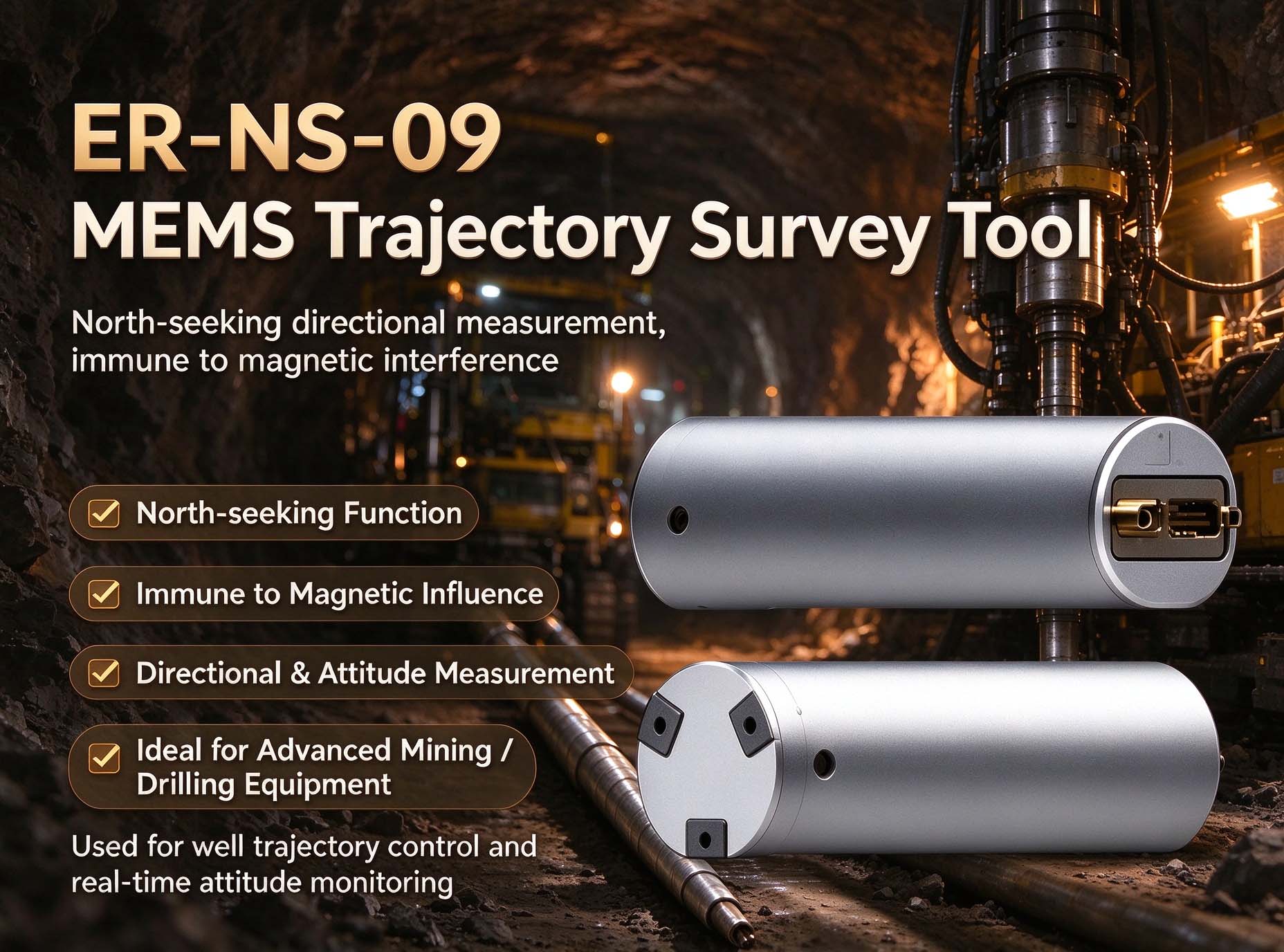
To address these requirements, Ericco offers the ER-MNS-09 MEMS Directional Module, designed for integration into mining well trajectory measurement devices and other directional measurement systems.
The ER-MNS-09 combines a three-axis MEMS gyroscope with a three-axis MEMS accelerometer in a strapdown inertial measurement architecture. It determines geographic true north by measuring the Earth's rotation component rather than relying on the geomagnetic field. This makes the technology suitable for applications where magnetic interference can compromise conventional compass-based measurements.
With multiple diameter options, a lightweight structure, and variants designed for different operating temperatures, the ER-MNS-09 provides equipment manufacturers with a compact inertial sensing solution for underground directional measurement.
Key Technical Advantages of the ER-MNS-09
2.1 Non-Magnetic North Finding for Underground Environments
Reliable azimuth information is essential for directional drilling and borehole trajectory measurement. When magnetic interference is present, a conventional magnetic compass or fluxgate-based system may experience heading errors, depending on the installation and surrounding environment.
The ER-MNS-09 uses a high-precision MEMS gyroscope to detect the Earth's rotation component and establish a geographic true-north reference. Because this north-finding method does not depend on the geomagnetic field, it offers an alternative for measurement applications involving metal structures, underground machinery, and other magnetically challenging environments.
The module supports an azimuth measurement range of 0° to 360° and provides a static north-finding function. According to the published specifications, the nominal azimuth accuracy is 1° secψ for the A and HA variants and 0.5° secψ for the B and HB variants, expressed using the manufacturer's original 1σ notation.
Actual measurement performance depends on factors such as alignment, installation, temperature, vibration, calibration, and measurement conditions. Engineers should therefore evaluate the selected configuration against their application's accuracy requirements rather than assuming identical performance in every operating environment.
2.2 Compact Dimensions for Narrow Probe Integration
The physical dimensions of a directional module can directly affect the mechanical design of a mining trajectory measurement instrument. In many applications, the sensing unit must fit inside a narrow probe tube while leaving sufficient space for connectors, structural supports, and other electronic components.
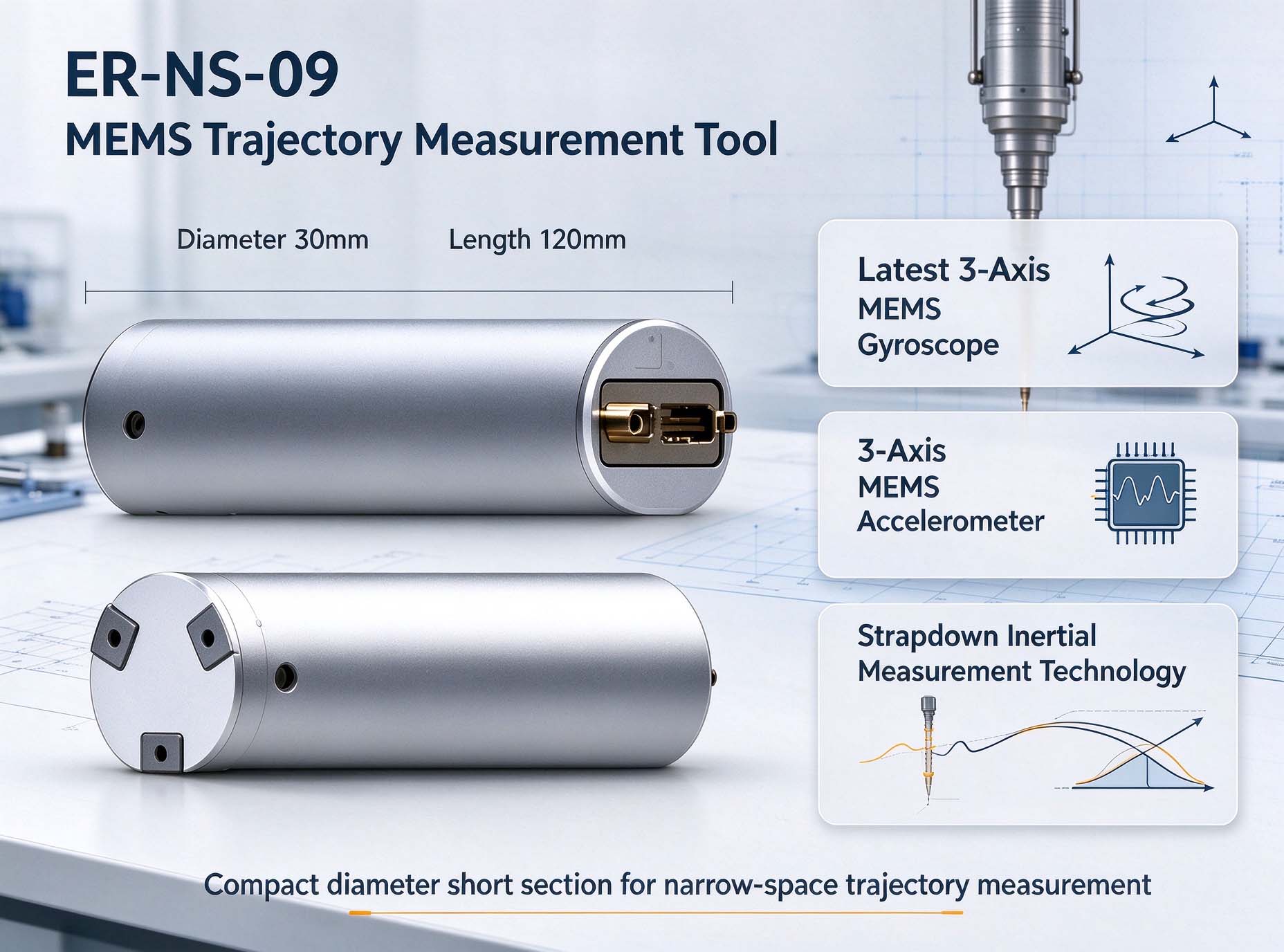
The ER-MNS-09 features a specially designed cylindrical form factor and offers three diameter options:
- Φ30 mm × 120 mm
- Φ25.4 mm × 120 mm
- Φ18.6 mm × 120 mm
The published product weight is no more than 150 g.
These options allow equipment manufacturers to select a configuration that matches their probe dimensions and mechanical layout. The compact design can also simplify the development of smaller directional measurement instruments where installation space is limited.
Before integration, designers should verify the available internal diameter, connector clearance, mounting reference, cable routing, and required mechanical tolerances. Selecting the appropriate size at the beginning of a project can help reduce unnecessary redesign during system development.
2.3 Three-Axis MEMS Inertial Measurement for Direction and Attitude Reference
The ER-MNS-09 adopts a strapdown inertial measurement architecture incorporating a three-axis MEMS gyroscope and a three-axis MEMS accelerometer.
The gyroscope senses angular motion, while the accelerometer measures specific force. Together with the appropriate measurement processing and attitude computation, these sensors provide the inertial information required for directional and attitude reference functions.
The module supports azimuth measurement, real-time output of carrier attitude reference values, and attitude-holding functionality. Its published attitude accuracy is ≤0.2° (1σ), with an inclination measurement range of -85° to +85°.
For mining trajectory measurement equipment, these capabilities can provide essential orientation information for subsequent borehole trajectory calculations, drilling direction assessment, and measurement data recording.
It is important to distinguish orientation sensing from complete three-dimensional positioning. The ER-MNS-09 is a directional module, not a standalone solution that automatically generates a complete borehole trajectory. Applications requiring spatial coordinates need an appropriate measurement procedure, survey station information, and a compatible trajectory calculation algorithm.
2.4 Solid-State Construction for Demanding Operating Conditions
Mining and drilling equipment can experience mechanical shock, vibration, and continuous operation under demanding conditions. Sensor construction and mechanical installation are therefore important considerations when designing reliable underground measurement systems.
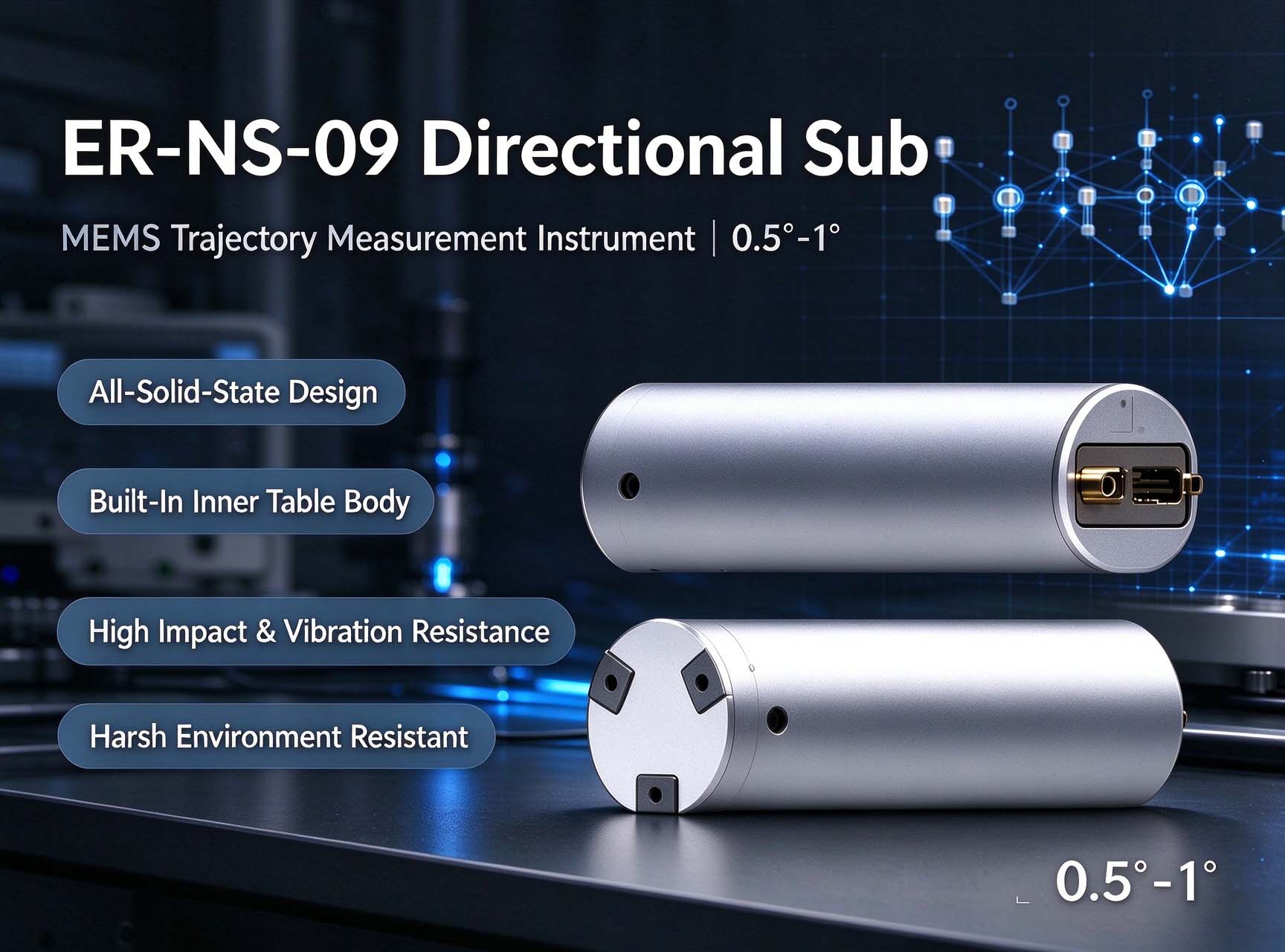
The ER-MNS-09 uses an all-solid-state design with a built-in platform structure. Its design emphasizes shock and vibration resistance, supporting integration into compact directional measurement instruments.
Nevertheless, actual system durability depends on the complete assembly, including the mounting structure, electrical connections, housing, and operating conditions. Equipment manufacturers should conduct appropriate vibration, shock, and operational stability tests based on the expected drilling environment.
Proper mechanical fixation, cable management, and calibration procedures are also important for maintaining measurement consistency.
2.5 Temperature Options for Different Applications
Temperature requirements vary depending on drilling depth, equipment location, geological conditions, and operating procedures. A directional module intended for a conventional underground application may not be suitable for a project with significantly higher operating temperatures.
The ER-MNS-09 is available in standard-temperature and high-temperature variants.
According to the published specifications, the standard variants operate from +5°C to +55°C, while the high-temperature variants operate from +5°C to +125°C. Their respective storage temperature ranges are 0°C to +65°C and 0°C to +130°C.
Because the operating limits differ by variant, purchasers should confirm the exact model designation and verify its temperature specifications before selecting the module. Where measurement accuracy at elevated temperatures is critical, the complete system should also be evaluated under representative operating conditions.
ER-MNS-09 Technical Specifications
ParameterPublished specificationModelER-MNS-09A, ER-MNS-09B, ER-MNS-09HA, ER-MNS-09HBAzimuth accuracy (1σ)A/HA: 1° secψ; B/HB: 0.5° secψAttitude accuracy (1σ)≤0.2°Azimuth measurement range0° to 360°Inclination measurement range-85° to +85°North-finding timeApproximately 3 minutesNorth-finding methodStaticUpdate rate100 HzSupply voltage6–12 VPower consumption3 WCommunication interfaceRS-422DimensionsΦ30 × 120 mm, Φ25.4 × 120 mm, or Φ18.6 × 120 mmWeight≤150 gStandard operating temperature+5°C to +55°CHigh-temperature operating range+5°C to +125°CStandard storage temperature0°C to +65°CHigh-temperature storage range0°C to +130°C
| Parameter | Published specification |
|---|---|
| Model | ER-MNS-09A, ER-MNS-09B, ER-MNS-09HA, ER-MNS-09HB |
| Azimuth accuracy (1σ) | A/HA: 1° secψ; B/HB: 0.5° secψ |
| Attitude accuracy (1σ) | ≤0.2° |
| Azimuth measurement range | 0° to 360° |
| Inclination measurement range | -85° to +85° |
| North-finding time | Approximately 3 minutes |
| North-finding method | Static |
| Update rate | 100 Hz |
| Supply voltage | 6–12 V |
| Power consumption | 3 W |
| Communication interface | RS-422 |
| Dimensions | Φ30 × 120 mm, Φ25.4 × 120 mm, or Φ18.6 × 120 mm |
| Weight | ≤150 g |
| Standard operating temperature | +5°C to +55°C |
| High-temperature operating range | +5°C to +125°C |
| Standard storage temperature | 0°C to +65°C |
| High-temperature storage range | 0°C to +130°C |
Note: Specifications are summarized from the manufacturer's product page. The original azimuth accuracy notation, ° secψ, is retained. Temperature limits depend on the selected variant. Confirm the latest datasheet, accuracy definitions, test conditions, and interface requirements with Ericco before final system design.
Applications of the ER-MNS-09 MEMS Directional Module
4.1 Mining Borehole Trajectory Measurement
Borehole trajectory measurement is important in coal mine gas drainage, geological exploration, water hazard prevention, and other directional drilling operations. Engineers need to determine whether a borehole is following its planned direction and assess its trajectory using measurements collected along the borehole.
Integrated into a compatible mining trajectory measurement instrument, the ER-MNS-09 provides inertial directional and attitude information. Combined with survey procedures and trajectory calculation software, these measurements can support borehole direction monitoring, trajectory analysis, and engineering documentation.
The overall result depends on the complete measurement system, including survey intervals, calibration, data processing, and operating procedures.
4.2 Directional Drilling Equipment
Directional drilling systems require information about tool orientation and drilling direction. A compact MEMS directional module can provide a practical sensing option when the available installation space is restricted.
The ER-MNS-09 supports integration into directional drilling equipment that needs azimuth and attitude reference data. Equipment manufacturers can incorporate the module into their own measurement and control architectures, subject to the requirements of the complete system.
The module itself does not determine all drilling control functions. Final control performance depends on the controller, software, mechanical design, and other sensors used in the equipment.
4.3 Underground Pipeline Tracking and Horizontal Directional Drilling
Underground pipeline installation and horizontal directional drilling (HDD) require careful monitoring of the planned drilling path. Reliable directional reference information can help engineers assess the drilling direction and document the progress of underground construction.
The ER-MNS-09 offers a non-magnetic north-finding approach and compact mechanical dimensions for suitable directional measurement systems. These characteristics can be useful when conventional magnetic heading measurements are affected by nearby metal structures or when a small probe is required.
System designers should evaluate the module alongside the complete HDD measurement architecture, including mechanical integration, data communication, and trajectory computation.
4.4 Tunnel Construction and Surveying Systems
Tunnel construction and underground surveying projects may require a dependable orientation reference for positioning and alignment tasks.
The ER-MNS-09 can provide directional or attitude reference information for compatible surveying instruments, pointing equipment, and specialized measurement systems. Its suitability for a particular application depends on the required accuracy, installation geometry, interface configuration, and system-level validation.
4.5 Geophysical Exploration and Mobile Mapping
Geophysical exploration and land-based mobile mapping may also involve directional measurement in environments where magnetic conditions are challenging or equipment dimensions are restricted.
The ER-MNS-09 can be evaluated as an inertial directional component in systems that require a true-north reference and attitude information. Integration should be based on the application's motion conditions, measurement accuracy requirements, and data-processing architecture.
How to Select the Right ER-MNS-09 Variant
Choosing a directional module involves more than comparing a single accuracy figure. The correct configuration should match the project's mechanical, environmental, and electrical requirements.
Step 1: Define the required azimuth accuracy.
The ER-MNS-09A and ER-MNS-09HA have a published azimuth accuracy of 1° secψ, while the ER-MNS-09B and ER-MNS-09HB are specified at 0.5° secψ. Select the appropriate option according to the required measurement performance and confirm the manufacturer's accuracy definition and applicable test conditions.
Step 2: Confirm the operating temperature.
For applications that may reach +125°C, confirm whether a high-temperature variant is required. Verify the operating and storage limits, along with the expected measurement performance under the actual thermal conditions.
Step 3: Match the module to the probe dimensions.
Choose between the Φ30 mm, Φ25.4 mm, and Φ18.6 mm configurations according to the available installation space. Account for the connector, mounting structure, cable routing, and mechanical tolerances rather than considering the sensor body alone.
Step 4: Verify electrical compatibility.
The module operates from a 6–12 V supply, consumes 3 W, and uses an RS-422 communication interface. System designers should confirm the power supply, communication settings, data protocol, and connector pinout before integration.
Step 5: Validate the complete measurement system.
Installation alignment, calibration, vibration, temperature, and trajectory algorithms can influence final measurement results. Conduct system-level tests under representative operating conditions and establish a suitable calibration and maintenance procedure.
Why Consider the ER-MNS-09 from Ericco?
For mining equipment manufacturers and underground engineering integrators, the choice of an inertial directional module affects not only measurement capability but also mechanical design, power consumption, environmental compatibility, and development effort.
The ER-MNS-09 combines non-magnetic north finding, three-axis MEMS inertial sensing, a compact cylindrical structure, and multiple configuration options. It is designed for applications that require directional and attitude reference information within a restricted installation space.
Its principal value lies in offering a flexible component-level solution for mining borehole trajectory measurement, directional drilling equipment, underground pipeline projects, and compatible surveying systems.
Before placing an order, engineering teams should define their accuracy requirements, operating temperature, available probe diameter, and communication needs. Ericco can then help clarify the appropriate model and provide the technical information needed for integration planning.
Conclusion
As mining, underground drilling, and subsurface engineering projects demand increasingly reliable trajectory measurements, inertial directional technology offers an important alternative for applications affected by magnetic interference or limited installation space.
The ER-MNS-09 MEMS Directional Module combines static non-magnetic north finding, three-axis inertial sensing, compact dimensions, and temperature-dependent model options to support the development of directional measurement instruments.
For manufacturers developing mining borehole survey tools, directional drilling systems, or underground surveying equipment, the ER-MNS-09 is worth evaluating as a compact inertial sensing component.
Visit the official ER-MNS-09 product page to review its specifications and contact Ericco for model selection, technical documentation, and integration support.