

Quick Answer
A north seeker (north finder) is a gyro-based instrument that finds true north without GPS or a magnetic compass. Six factors decide which one you need: azimuth accuracy, static vs dynamic measurement, measurement time, operating temperature, size and interfaces, and cost. Static north seekers give the best accuracy at rest; dynamic models work on moving platforms. MEMS models balance cost and size, while FOG models deliver the highest precision. Match the accuracy you actually need, not the highest spec, then check temperature rating, integration fit, and budget before you buy.
A north seeker looks simple until you have to pick one. The idea behind it is easy: a gyro-based instrument that finds true north without GPS or a compass, so it works in a mine hundreds of meters underground, inside a steel building, or on a rig where the local magnetic field is a mess. The hard part is that "a north seeker" is not one product. Accuracy, measurement mode, environment, integration, and price all move in different directions, and the spec sheet alone will not tell you which combination fits your job.
This article goes through what the specifications actually mean, which ones matter in practice, and how the main types map to real work. If you only want the short version, the Quick Answer above and the comparison table cover it. The rest is the reasoning behind those two.
What Is a North Seeker?
A north seeker, also called a north finder or gyro north finder, is a gyro-based instrument that works out true north from the Earth's rotation. It does not measure a magnetic field, and it does not need a satellite signal.
Inside, a gyroscope senses the Earth's rotation while the instrument is held still. Because that rotation points at true north in the horizontal plane, the instrument can calculate its own heading relative to true north on its own. No magnetic reference, no GPS, no view of the sky.
That makes it the tool of choice in three places where other instruments fail:
- Underground, where GPS does not reach and a compass cannot be trusted.
- Near steel, electrical equipment, or magnetic formations, where a compass lies.
- Wherever the job demands true north rather than magnetic north, as surveying, alignment, and geodetic work usually do.
North seekers come in a wide range of forms. There are small modules that an engineer can embed in a custom tool, standalone units you level and read on site, and complete alignment systems built for a specific machine.
How a North Seeker Works
The Gyrocompassing Principle
Every north seeker works on the same idea: gyrocompassing. The Earth rotates once a day, and part of that rotation lies in the horizontal plane, always pointing at true north.
Hold a gyroscope still, and it senses that rotation. Compare the measured rotation against the vertical reference from the accelerometers, and you get the angle between the instrument and true north. No magnetic environment is involved at any step.
That is why a north seeker works inside a steel building, in a tunnel under a river, or hundreds of meters underground. Nothing magnetic can fool it.
Static vs Dynamic North Finding
North seekers split into two operating modes, and this is the first decision you actually have to make. Not the accuracy spec, not the brand: static or dynamic.
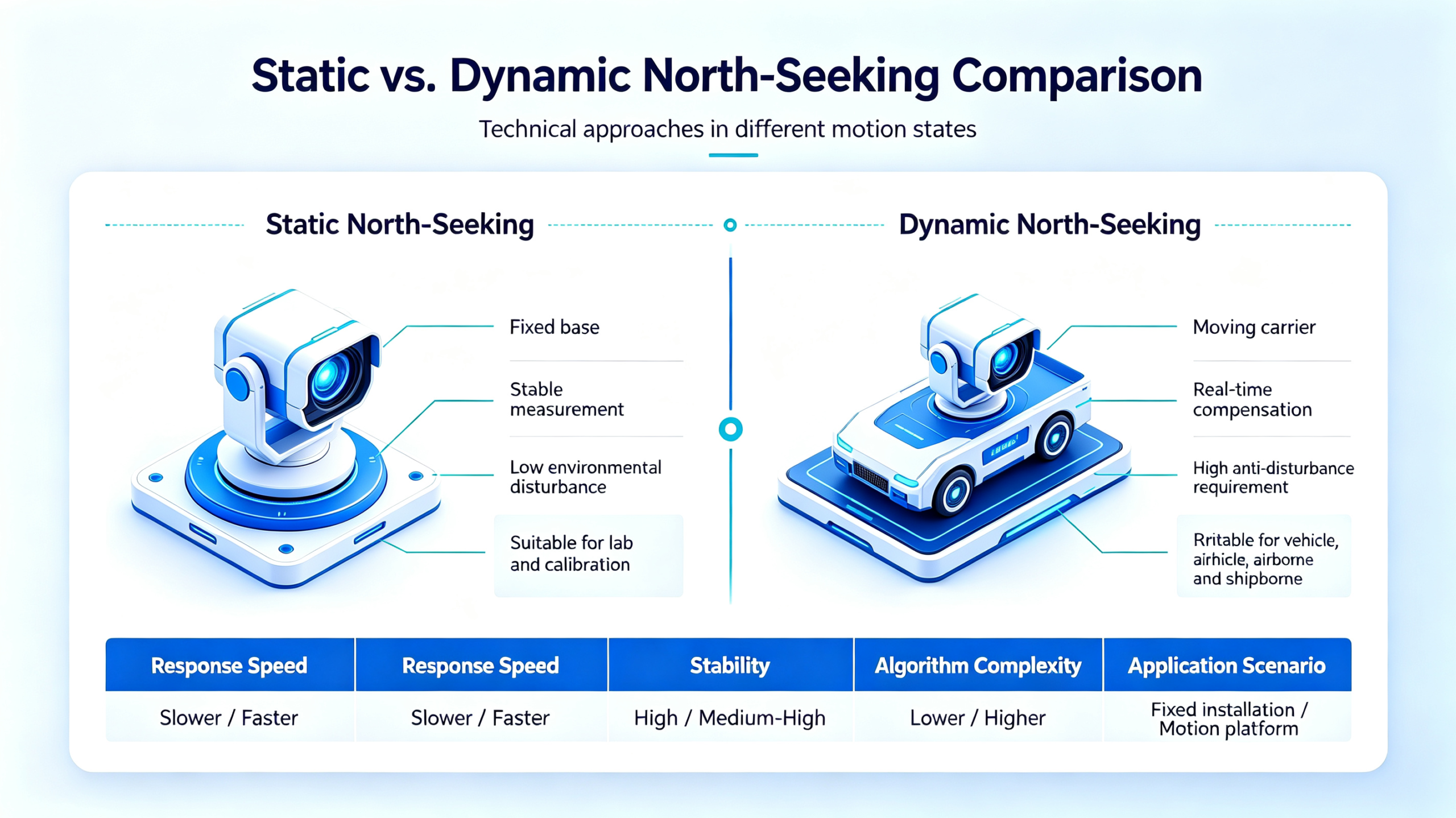
Static north seeking. The instrument stays still while it measures. The longer it integrates the Earth's rotation signal, the more accurate the reading becomes. Static instruments give the best accuracy available, but the platform cannot move during the measurement.
Dynamic north seeking. The instrument measures while the platform moves, on a vehicle, a vessel, a drilling rig, or a machine at work. Instead of one long stationary integration, it fuses the gyroscope, the accelerometers, and any aiding data it can get, such as GNSS or odometer signals, to keep tracking heading in real time. Dynamic models give up some peak accuracy in exchange for working on moving platforms.
Neither mode is better than the other. The only question is whether your platform moves while you need the heading.
The Six Factors That Decide Your North Seeker
1. Azimuth Accuracy
Accuracy is the first number people ask for and the easiest one to misuse. North seeker accuracy is usually quoted as a heading error in degrees, for example 0.1°, 0.5°, or 1°.
The real question is what your application can live with. Orienting a borehole tool might need 0.1°-level accuracy. Aligning a mining machine to a tunnel axis may be fine at 0.5°. A general orientation reference can tolerate 1°.
Accuracy is the biggest driver of price in a north seeker, and buying more than you need is the most common way to overpay. A lot of buyers who think they need FOG-level precision change their minds once they look at the tolerance of the actual job.
2. Static or Dynamic Measurement
This was covered above, but it is worth repeating because it is the mistake we see most often in the field. If the platform is still during measurement, a static instrument gives you the best accuracy per dollar. If it moves, you need a dynamic model, period.
Some situations are hybrid. A dynamic model can also run statically, but a static model cannot follow a moving platform.
3. Measurement Time
Static instruments need time to integrate the Earth's rotation signal. Times run from a few seconds to a few minutes, and there is a direct trade-off: more integration time, better accuracy.
If your crew takes a reading every few minutes anyway, a slower instrument costs you nothing. If you need a heading in a hurry, for a time-critical alignment for instance, measurement time can decide the purchase. Check the time needed at the accuracy you require, not just the headline accuracy figure.
4. Operating Environment
North seekers end up in rough places. Before comparing spec sheets, check these:
- Temperature. A unit rated for a lab at 25°C will not survive a rig in the desert or an underground mine. Match the operating range to your actual conditions, and ask whether the accuracy figure holds across that range.
- Shock and vibration. Static instruments need a stable platform. Dynamic ones have to live through continuous vibration. Check the ratings against your equipment.
- Magnetic sources near the instrument. A north seeker ignores magnetism by design, but the steel around it still distorts the local field during measurement. For the best accuracy, keep magnetic masses away from the unit while it works.
- Protection. Dust, moisture, and the IP rating matter more in the field than they look on paper.
5. Size, Weight, Interfaces, and Integration
How will the instrument actually be used?
- As a standalone unit. Handheld or tripod-mounted, leveled, and read on site. No integration work, fastest to deploy.
- As a module to embed. A north seeking module with defined electrical interfaces, such as serial, CAN, or Ethernet, that you build into your own tool. This is how directional tools and specialized instruments are made.
- As an integrated system. A complete alignment system for a specific machine, delivered ready to install.
Check the mechanical envelope, weight, power, and interface against your constraints. A north seeker with perfect specs but the wrong interface is an expensive paperweight.
6. Cost
Prices span a wide range, and the ladder is mostly driven by accuracy, technology, and measurement mode:
- Entry level: low-cost single-axis models.
- Mainstream: MEMS static and dynamic models.
- Top end: FOG models, justified only when maximum precision is genuinely required.
Set the budget after you have pinned down accuracy, mode, environment, and integration, not before. The cheapest instrument that meets all four is the right purchase. The cheapest instrument alone usually is not.
North Seeker Types Compared
|
Type
|
Measurement mode
|
Accuracy tier
|
Form factor
|
Best for
|
Price tier
|
|
Low-cost single-axis MEMS
|
Static
|
Moderate
|
Small module
|
Cost-sensitive orientation, entry-level instruments
|
Entry
|
|
MEMS static north seeker
|
Static
|
Good
|
Module or standalone
|
General surveying, alignment, borehole orientation
|
Mainstream
|
|
MEMS dynamic north seeker
|
Dynamic
|
Good, on moving platforms
|
Module or unit
|
Vehicles, vessels, moving platforms, in-motion orientation
|
Mainstream
|
|
FOG north seeker
|
Static / dynamic
|
Highest
|
Larger unit
|
Maximum precision, demanding geodetic and oil & gas work
|
Premium
|
|
North-seeking directional module
|
Static
|
Good
|
Bare module
|
Embedding into your own directional tool
|
Mainstream
|
|
Integrated alignment system
|
Static
|
Good
|
Complete system
|
Machine-specific alignment (e.g., mining equipment)
|
System pricing
|
Step-by-Step: How to Choose a North Seeker
Six steps, in order. Skip one and you pay for it later.
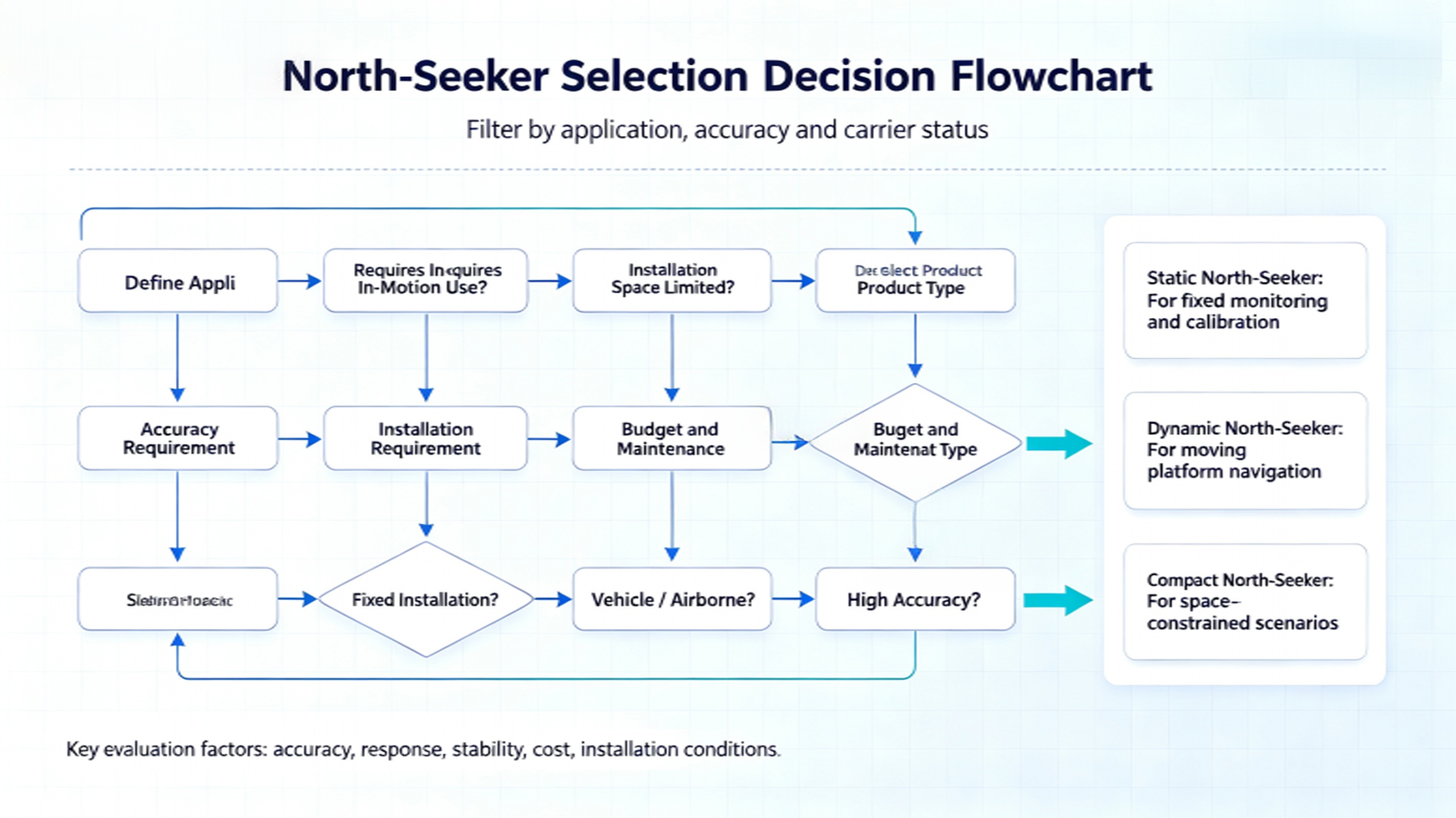
Step 1: Define the platform. Stationary during measurement, or moving? That decides static vs dynamic, the biggest structural choice.
Step 2: Define the accuracy requirement. What azimuth error can the application tolerate? Write the number down in degrees. Do not round up to a nicer, higher spec unless you have a reason.
Step 3: Define the environment. Temperature range, shock and vibration, dust and moisture, and any magnetic masses near the measurement point.
Step 4: Define the integration. Standalone, module to embed, or complete system? What interfaces, power, and envelope do you have available?
Step 5: Define the budget. Now that you know the type, look at the price tiers. If the type you need exceeds the budget, go back to steps 2 and 3. Do you really need that accuracy, or that temperature rating?
Step 6: Verify before you buy. Ask the supplier for the accuracy figure at your operating temperature, not just at room temperature. If you can, test the unit, or ask for reference data from similar deployments.
North Seeker Selection by Application
Oil and Gas
In oil and gas, north seekers orient drilling equipment, align pipelines and storage facilities, and provide surface references for downhole directional work. Static high-accuracy models are common for rig and facility orientation. Dynamic models serve moving platforms and rotating equipment. Temperature rating is a hard requirement in desert and offshore conditions.
Mining and Underground Engineering
Mining is where a north seeker earns its keep. Underground there is no GPS, and magnetic interference from iron-rich rock, steel supports, and electrical installations makes compasses unreliable. The north seeker provides the true-north reference needed to orient heading machines, align drilling rigs, and set tunnel and drift directions. Integrated alignment systems for mining equipment, including hydraulic support alignment, are a growing application.
Geophysical Exploration
Exploration crews need accurate orientation of borehole tools and surface instruments. A north seeker gives them a non-magnetic, GPS-independent reference, at the surface or downhole. Accuracy and ruggedness come first here.
Surveying and Mapping
Surveyors use a north seeker to establish true north where magnetic methods fall short or where high accuracy is required, such as boundary surveys, engineering alignment, and control networks. The portable standalone form is the usual choice.
How Ericco's North Seeker Families Map to These Needs
Ericco makes the full family, from entry-level single-axis models to FOG instruments, so the selection process above maps onto real products. Here is how the families are positioned:
- Dynamic north seekers (ER-MNS-04AB, ER-MNS-05A) are for moving platforms and in-motion north finding: vehicles, vessels, and equipment that cannot stop to measure.
- Cost-effective static models (ER-MNS-06A) cover mainstream static applications without the premium price.
- Ultra-low-cost single-axis models (ER-MNS-08) sit at the entry level for cost-sensitive projects that just need a basic true-north reference.
- North-seeking directional modules (ER-MNS-09) are bare modules for engineers embedding north finding in their own directional tools.
- Hydraulic support alignment models (ER-MNS-10A) target mining-specific alignment work.
- FOG north seekers are the high-precision tier, for applications that genuinely require maximum accuracy.
- Integrated mining gyro alignment tools (YHZ90/360 series) are complete, ready-to-install alignment systems for mining equipment.
The right choice is not the most expensive model. It is the one that matches your accuracy, mode, environment, and integration at the right price. Describe your application to our engineers and we will map it to the correct family.
Common Mistakes When Choosing a North Seeker
Mistake 1: Choosing static when your platform moves. A static north seeker on a moving platform produces garbage data. If the platform moves during measurement, you need a dynamic model. This single mistake accounts for most of the field failures we hear about.
Mistake 2: Overbuying accuracy. FOG-level precision is expensive. If your application tolerates 0.5°, a MEMS model at 0.5° is the right buy, not a FOG model at 0.1°.
Mistake 3: Ignoring the temperature spec. Datasheet accuracy is usually quoted at room temperature. Ask for the figure at your operating temperature; the two can diverge significantly.
Mistake 4: Forgetting the measurement time. A high-accuracy static model that needs five minutes per reading may be unusable in a workflow that wants a heading every 30 seconds.
Mistake 5: Overlooking integration constraints. The best module is useless if its interface, power, or envelope does not fit your tool. Verify interfaces before finalizing the choice.
Mistake 6: Confusing north seeking accuracy with heading accuracy during motion. A dynamic model's accuracy is specified for its operating mode. Read the accuracy statement together with the mode and the conditions it was measured under.
FAQ
Q: What is a north seeker?
A: A north seeker (north finder) is a gyro-based instrument that determines true north using the Earth's rotation. It does not need GPS or a magnetic compass, so it works indoors, underground, and in magnetically disturbed environments.
Q: What is the difference between static and dynamic north seeking?
A: Static north seeking measures while the instrument is held still, integrating the Earth's rotation signal for the highest accuracy. Dynamic north seeking measures on a moving platform, using sensor fusion and aiding data to track heading in real time.
Q: What is the difference between MEMS and FOG north seekers?
A: MEMS north seekers are smaller, lower-cost, and lower-power, with good accuracy for most applications. FOG (fiber optic gyroscope) north seekers are larger and more expensive but deliver the highest precision, justified when maximum accuracy is genuinely required.
Q: Does a north seeker need GPS?
A: No. A north seeker is self-contained and finds true north from the Earth's rotation. That is its core advantage in GPS-denied environments such as mines, tunnels, and indoor facilities.
Q: What accuracy do I need?
A: It depends on the application. Orienting a borehole tool may need 0.1°-level accuracy; aligning mining equipment may be fine with 0.5°; general orientation may tolerate 1°. Define your acceptable azimuth error before comparing models.
Q: How much does a north seeker cost?
A: Prices span a wide range, driven mainly by accuracy, technology, and measurement mode. Entry-level single-axis models are the most economical; MEMS static and dynamic models occupy the mainstream; FOG models are the premium tier. The right price is the one that matches your actual requirements.
Conclusion
The selection process sounds like a lot of steps, but in practice it collapses into two questions. Does the platform move while you need the heading? And what accuracy can the job live with? Everything else, environment, integration, and price, is a constraint you can work through once those two are answered.
Ericco builds the whole range, from entry-level single-axis models to MEMS static and dynamic north seekers, directional modules, mining alignment systems, and FOG instruments. We can match your application to the tier that fits, and tell you when a cheaper model is the honest recommendation. Send us your application details, including platform or hole type, temperature, accuracy target, and integration constraints, and we will come back with a specific recommendation instead of a catalog.