

Quick Answer
A fluxgate directional sensor measures the Earth's magnetic field to determine azimuth. It is low-cost, mature, and accurate but only in magnetically clean environments. A MEMS gyro directional module measures rotation rate and finds true north using the Earth's rotation, making it completely immune to magnetic interference. Choose fluxgate for simple, magnetically clean, cost-sensitive holes. Choose a MEMS gyro directional module for cased holes, magnetic formations, drill-string interference, or any operation where trajectory accuracy matters more than sensor cost.
Every directional drilling operation whether it is an oil and gas well, a coal mine borehole, a gas drainage hole, or an HDD crossing faces the same fundamental question: how do you know where your drill bit is going? The answer comes down to one sensor decision. Downhole directional sensors determine azimuth and inclination, and the two most common technologies are fluxgate magnetometers and MEMS gyroscopes.
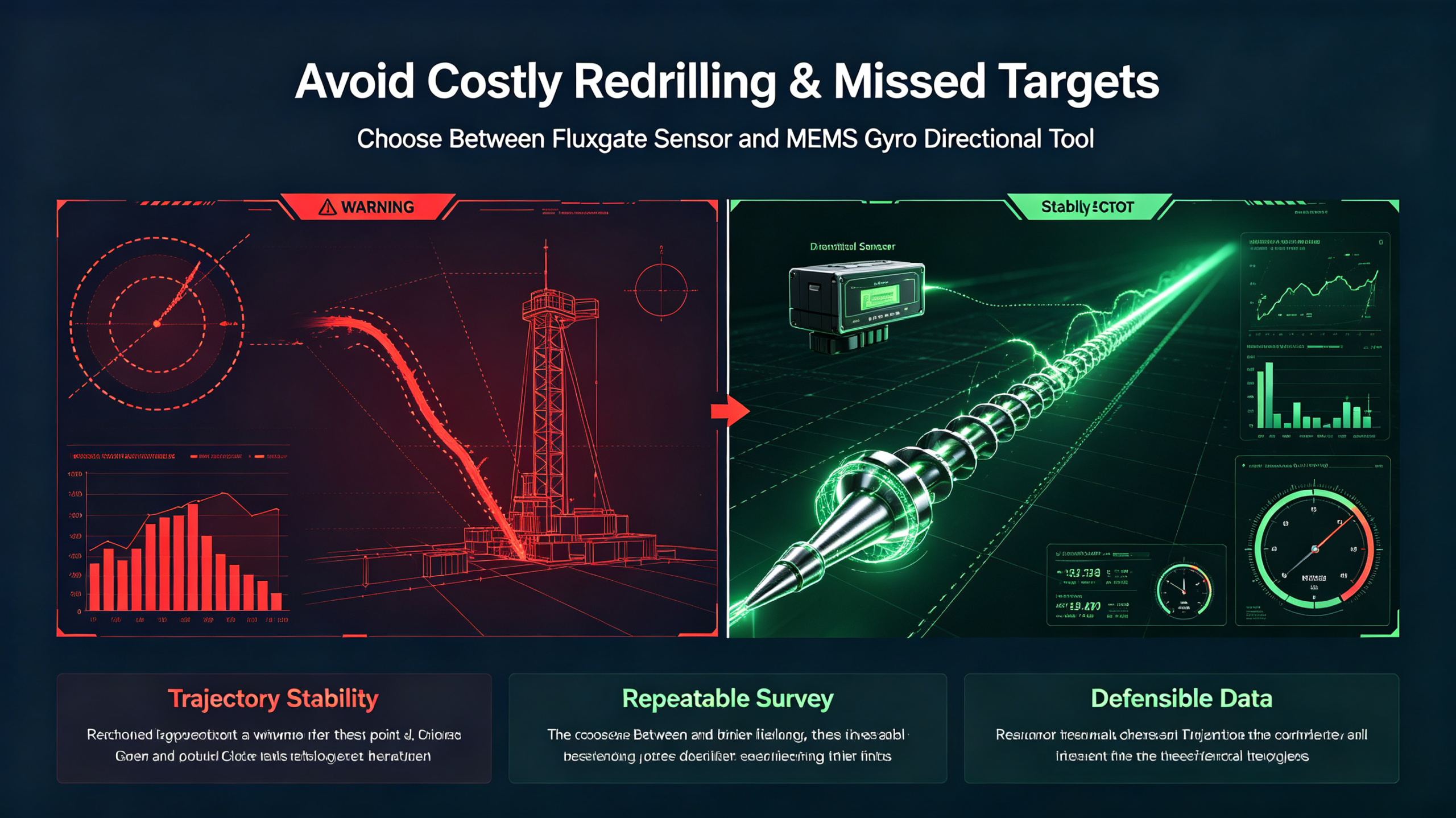
Choose wrong, and you pay for it in deviated holes, missed targets, redrilling costs, and lost time. Choose right, and your trajectory measurement is stable, repeatable, and defensible.
This guide compares fluxgate directional sensors and MEMS gyro directional modules across every dimension that matters working principle, magnetic interference immunity, accuracy, temperature rating, drift, cost, and integration. By the end, you will know exactly which downhole directional sensor fits your operation and why.
What Is a Fluxgate Directional Sensor?
A fluxgate directional sensor is a magnetic-based sensor that measures the direction and strength of the Earth's magnetic field. It works on the fluxgate principle: a ferromagnetic core is driven into saturation by an excitation coil, and the resulting signal is proportional to the external magnetic field along that axis. A three-axis fluxgate measures the full magnetic field vector.
In a directional tool, the fluxgate is combined with a three-axis accelerometer. The accelerometer measures inclination (hole angle) and toolface. The fluxgate measures the horizontal component of the magnetic field. From these two measurements, the tool's software computes azimuth the angle between magnetic north and the tool's heading.
Fluxgate sensors are the industry standard in conventional MWD (measurement while drilling) and wireline survey tools. They are small, rugged, and inexpensive to manufacture. High-temperature versions are available for downhole service, including wireline fluxgate directional sensors rated for the hot conditions found in deep oil and gas wells.
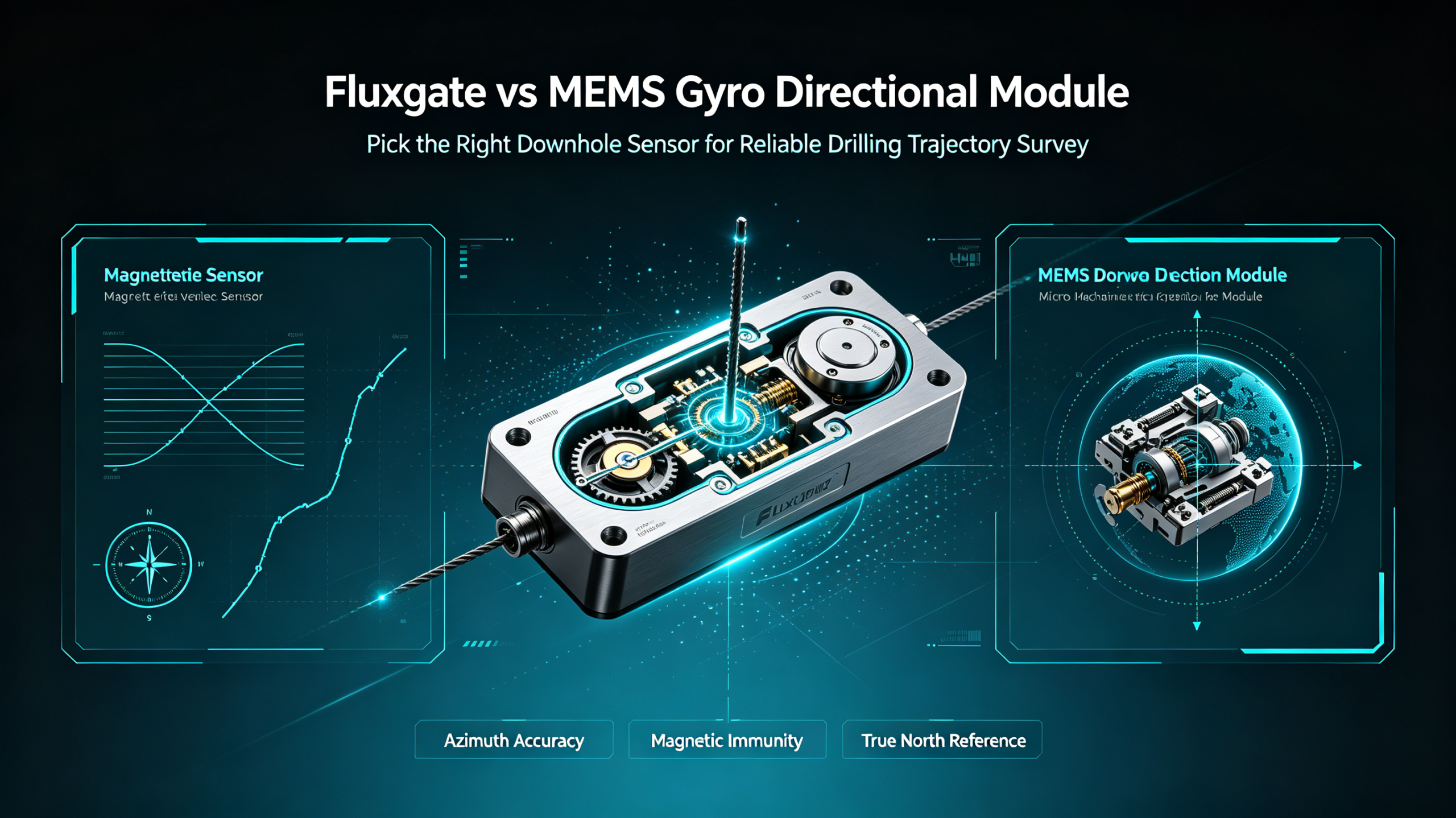
The core limitation of a fluxgate is built into its working principle: it measures a magnetic field. Anything that distorts the magnetic field distorts the azimuth reading. This is the single most important fact to understand when comparing fluxgate and gyro technologies.
How Magnetic Interference Breaks Down Fluxgate Accuracy
Magnetic interference reaches a downhole fluxgate from several directions at once, and each one adds error to the azimuth calculation.
Casing and drill string steel. Standard casing, drill pipe, stabilizers, and collars are made of magnetic steel. The remanent magnetization in these components creates an additional magnetic field that overlaps the Earth's field at the sensor location. The closer the fluxgate sits to magnetic steel, the larger the error.
Magnetic formations. Some rock types basalt, iron ore, and certain mineralized zones have high magnetic susceptibility. They distort the Earth's magnetic field locally, sometimes dramatically. This is why fluxgate-based surveying in mining districts is notoriously unreliable.
Hard and soft iron effects. Hard iron is a constant magnetic offset that can be partly removed by calibration. Soft iron is induced magnetization that changes with tool orientation and is much harder to compensate. In a changing magnetic environment, even a well-calibrated fluxgate drifts out of specification.
The practical consequence is simple: a fluxgate's datasheet accuracy is only valid in a magnetically clean field. In cased holes or magnetic formations, the real-world azimuth error can be several degrees enough to miss a target or create an unsafe trajectory.
What Is a MEMS Gyro Directional Module?
A MEMS gyro directional module measures angular velocity rather than magnetic field. The gyroscope is built on micro-electromechanical systems (MEMS) technology: a tiny vibrating structure experiences a Coriolis force when the sensor rotates, and that force is proportional to the rotation rate. By integrating the rotation rate over time and combining it with accelerometer data, the module computes the tool's attitude.
Unlike a compass, a gyro directional module does not need a magnetic reference. It finds true north through gyrocompassing sensing the Earth's rotation axis and deriving true azimuth from it. This is the same physical principle used by large marine gyrocompasses, now miniaturized into a module small enough to fit inside a downhole tool.
This is why MEMS gyro directional modules are often described as gyro tools: they are the core of gyro while drilling (GWD) and gyro survey tools. Because they do not rely on magnetism, they deliver stable azimuth readings in environments where a fluxgate would fail.
The main engineering challenges for a gyro module are drift and temperature. MEMS gyroscopes exhibit bias drift, which accumulates as angular error over time. High-grade modules manage this through continuous measurement, periodic referencing, and temperature compensation across the operating range.
How Gyrocompassing Works in a Downhole Tool
To understand why a gyro module ignores magnetism, it helps to see the measurement process in action.
First, the tool is held stationary (or nearly so) while the gyroscopes sense the tiny angular rate of the Earth's rotation about the local vertical. Because the Earth's rotation axis is fixed in space, the horizontal component of that rotation points toward true north. The module measures this horizontal component, compares it with the accelerometer-derived vertical reference, and solves for true azimuth.
This initial alignment is called gyro compassing. It requires a stable platform during the measurement window and a gyroscope sensitive enough to resolve the Earth's rotation rate—which is on the order of 15 degrees per hour against the module's own noise.
During continuous measurement while drilling, the gyro tracks the tool's rotation rate in real time. Drift is managed by keeping measurement windows short, by periodically re-referencing, and by compensating the bias across the temperature range. The result is a true-north-referenced azimuth that no magnetic field can corrupt.
Fluxgate vs MEMS Gyro Directional Module: Head-to-Head Comparison
| Dimension | Fluxgate Directional Sensor | MEMS Gyro Directional Module |
| Working principle | Measures Earth's magnetic field vector | Measures angular rate; finds true north via Earth's rotation |
| Magnetic interference | Susceptible: casing, drill string, magnetic formations distort readings | Immune: no magnetic reference required |
| Azimuth accuracy | Good in clean fields; degrades sharply near magnetic sources | Stable and repeatable, including in magnetic environments |
| Inclination range | Full range with accelerometer | Full range with accelerometer; high accuracy even at small inclinations |
| Drift | No drift in sensing; errors come from magnetic field distortion | Gyro bias drift accumulates over time; managed by design |
| Calibration | Hard/soft iron calibration required; re-calibration near magnetic sources | Factory calibrated; temperature compensated |
| Temperature rating | High-temp versions available for deep wells | High-temp versions available; compensation is critical |
| Cost | Lower | Higher |
| Best for | Magnetically clean holes, cost-sensitive operations | Cased holes, magnetic formations, accuracy-critical trajectory |
Fluxgate vs MEMS Gyro by Application
The right choice also depends on the industry you work in. Here is how the fluxgate-versus-gyro decision typically plays out across the core directional-drilling applications.
- Oil and gas directional drilling. Conventional MWD runs on fluxgate sensors and works well in magnetically clean, uncased open hole. But the moment you survey inside casing, drill near a magnetic anomaly, or perform a casing exit, you need gyro capability. That is why gyro tools and gyro while drilling (GWD) are standard for cased-hole surveys and complex well trajectories.
- High-temperature rating 150°C and above is a hard requirement in deeper wells. Mining and underground engineering. Coal mines and metal mines are some of the most magnetically hostile environments on Earth. Iron-rich formations, electrical installations, and steel support corrupt magnetic surveys everywhere. For mine borehole trajectory measurement, gas drainage holes, and heading machine orientation, MEMS gyro directional modules are increasingly the preferred solution because they remove magnetic interference from the error budget entirely.
- HDD and trenchless construction. Horizontal directional drilling for pipelines and utilities often crosses urban areas, rivers, and roads where buried steel and reinforced structures are everywhere.
- A gyro-based north seeker or directional module gives the operator a stable reference that does not depend on the magnetic environment at the surface or downhole. Geophysical exploration and borehole survey. Deep borehole surveys for mineral exploration and geotechnical work face both magnetic formations and the need for accurate, repeatable trajectories. Gyro modules provide the defensible data set that exploration and mine planning departments can rely on.
In every one of these industries, the question is the same: does your environment let you trust the magnetic field? If it does not, the gyro module is the answer.
When a Fluxgate Directional Sensor Is the Right Choice
Fluxgate sensors are not obsolete. In the right environment, they are the most economical and reliable choice.
Choose fluxgate when:
- The formation is magnetically clean. Sandstone, limestone, and most sedimentary rocks have low magnetic susceptibility. In these conditions, a quality fluxgate delivers accurate azimuth.
- The hole is cased with non-magnetic materials, or casing is far from the measurement point. Standard casing and drill pipe are magnetic When the sensor is located far enough from magnetic steel, readings remain clean.
- Cost is the dominant constraint. Fluxgate directional sensors are significantly less expensive than gyro modules. For high-volume, low-risk operations, the savings matter.
- Your existing MWD system is fluxgate-based. Integration cost can be lower when you stay within an established sensor ecosystem.
- Accuracy requirements are moderate. If small azimuth errors are acceptable, fluxgate is sufficient.
Fluxgate remains the default for a large share of conventional directional drilling. The problems appear when the environment is not magnetically clean and that is a growing problem in modern operations.
When a MEMS Gyro Directional Module Is the Right Choice
The case for a MEMS gyro directional module becomes compelling the moment magnetic interference enters the picture.
Choose a gyro module when:
- The hole is cased, or the survey point is near casing. Magnetic casing makes fluxgate readings unreliable. Gyro tools are the standard solution for cased-hole surveys and casing exit operations.
- The formation is magnetic. Basalt, iron ore, and other magnetic rocks distort the magnetic field. Mines, in particular, are notorious for magnetic anomalies. A gyro module is immune.
- The drill string or bottom-hole assembly creates magnetic interference. Magnetized steel in the BHA, stabilizers, and mud motors all corrupt fluxgate azimuth. Gyro measurement is unaffected.
- Trajectory accuracy is critical and must be defensible. When you need reliable, repeatable trajectory data for mine planning, regulatory reporting, or geosteering, gyro technology removes a whole class of error.
- Small inclination angles. Gyro modules maintain azimuth accuracy even at small hole angles, where fluxgate accuracy tends to drop.
- Operations in GPS-denied or magnetically disturbed underground environments. Underground mines, tunnels, and HDD crossings often have no magnetic reference worth trusting.
In short: anywhere you cannot trust the magnetic field, a gyro module is the only sensor that can still tell you where you are pointed.
Ericco MEMS Gyro Directional Module: A Direct Fluxgate Replacement
Ericco builds both fluxgate directional sensors and MEMS gyro directional modules which is exactly why we can give you an honest comparison. When the environment demands magnetic-interference-free measurement, our MEMS gyro directional module (such as the ER-MNS-09 series) is engineered as a direct replacement for the fluxgate module in your existing directional tool.
What "direct replacement" means in practice:
- Drop-in integration. The gyro module fits the same tool architecture and communicates over the same industry-standard interfaces, so switching does not require redesigning your tool.
- Gyro + accelerometer core. It outputs azimuth, inclination, and toolface the same data set you expect from a fluxgate assembly but computed from a gyro reference that ignores magnetism.
- Small-inclination accuracy. The module maintains effective azimuth and toolface precision even at small hole angles, a known weak point of fluxgate measurement.
- Rugged, all-solid-state design. MEMS construction gives superior shock and vibration resistance, which matters in demanding downhole and mining environments.
- Wide temperature operation. Modules are built and compensated for the hot conditions found in downhole service.
The result: you keep your existing tool and workflow, but your trajectory measurement becomes immune to the magnetic interference that has always been the weak link in fluxgate-based surveying.
What to Check When Evaluating a Gyro Directional Module
If you are comparing gyro modules from different suppliers, put these specifications on your checklist before you commit:
- Azimuth accuracy, stated with the operating conditions (inclination, temperature, measurement time). A number without conditions is meaningless.
- Bias instability and drift, which tell you how fast angular error accumulates and how the module manages it.
- Inclination range and small-angle performance, especially if you survey near-horizontal or near-vertical holes.
- Temperature rating and compensation range, matched to your real downhole temperature profile.
- Shock and vibration rating, matched to your drilling dynamics.
- Interface and integration fit, so the module drops into your existing tool without a redesign.
- Factory calibration and support, including documentation and engineering support for your integration.
A module that looks cheap on paper can be expensive in practice if it needs constant rework, cannot handle your temperatures, or produces data your engineers do not trust.
Common Mistakes When Choosing a Downhole Directional Sensor
Most directional-survey problems are not caused by the sensor itself they are caused by selecting the wrong sensor for the environment. Here are the mistakes we see most often:
Mistake 1: Assuming fluxgate accuracy in a magnetic environment. A fluxgate's datasheet accuracy assumes a clean magnetic field. In cased holes or magnetic formations, real-world accuracy can be several degrees worse than the datasheet suggests. Verify the actual environment before relying on the spec.
Mistake 2: Ignoring gyro drift management. Gyro modules are not magic. Bias drift accumulates over time. The right module manages this through measurement strategy and temperature compensation. Understand the module's drift characteristics and the recommended survey procedure before deployment.
Mistake 3: Not checking the temperature rating. Downhole temperature varies widely from shallow coal seams to deep oil wells. A sensor rated for 85°C will fail in a 175°C well. Match the sensor's temperature rating and compensation to the actual downhole profile, not the average.
Mistake 4: Choosing on price alone. The cheapest sensor can become the most expensive if it produces an inaccurate trajectory that leads to a redrill or a missed target. Evaluate total cost of the operation, not just the sensor cost.
Mistake 5: Ignoring shock and vibration. Directional tools live in a violent environment. All-solid-state MEMS gyro modules generally handle shock better than delicate magnetic sensors. Match the sensor's shock rating to the drilling dynamics of your operation.
Mistake 6: Skipping the verification survey. No sensor is perfect, which is why responsible operators run verification checks comparing against a reference survey, checking repeatability, or running a short gyro check at a known point. A sensor you verify is a sensor you can trust; a sensor you never verify is a gamble.
FAQ
Q: Can a MEMS gyro directional module really replace a fluxgate module?
A: Yes. A MEMS gyro directional module is designed as a drop-in replacement for fluxgate modules in directional tools. It outputs the same azimuth, inclination, and toolface data, but derives azimuth from the Earth's rotation instead of the magnetic field making it immune to magnetic interference.
Q: Which is more accurate: fluxgate or MEMS gyro?
A: In a magnetically clean environment, both can deliver good accuracy. In any environment with magnetic interference casing, magnetic formations, magnetized drill string the MEMS gyro module is significantly more accurate because it does not depend on the magnetic field at all.
Q: Do gyro directional modules need GPS or a surface reference?
A: No. A gyro module finds true north through gyrocompassing, using the Earth's rotation. It is fully self-contained and works underground, in tunnels, in cased holes, and in GPS-denied environments.
Q: What temperature ratings matter for downhole sensors?
A: The required rating depends on the well or borehole. Shallow mining applications may need only 85–105°C. Deep oil and gas wells can exceed 150°C, with high-end tools rated to 175°C or 200°C. Always match the sensor's rating to the actual downhole temperature profile.
Q: Which option is cheaper?
A: Fluxgate directional sensors are generally lower in cost. A MEMS gyro directional module carries a higher upfront price but can save money overall when it prevents inaccurate trajectories, redrills, and lost time in magnetic-interference environments.
Q: Does gyro drift make the measurement unreliable?
A: Drift is a real characteristic of MEMS gyroscopes, but it is a manageable one. High-quality modules combine continuous measurement, periodic referencing, and full-temperature compensation to keep accumulated error within acceptable limits over the survey duration.
Conclusion
The choice between a fluxgate directional sensor and a MEMS gyro directional module comes down to one question: can you trust the magnetic field where you are drilling?
If yes, fluxgate is the economical, proven workhorse. If no because of casing, magnetic formations, magnetized drill string, or an underground environment you cannot control a MEMS gyro directional module is the only reliable way to know where your bit is going.
Because Ericco manufactures both technologies, we do not have a one-size-fits-all agenda. We can help you match the right downhole directional sensor to your actual operating conditions, your accuracy requirements, and your budget.
Need to decide for your project? Contact our engineers with your application details hole type, depth, temperature, formation, and accuracy target and we will recommend the sensor that fits. For specifications and datasheets, request them through the product pages for our fluxgate directional sensors and MEMS gyro directional modules.